

Journal of Creation 16(2):95–104, August 2002
Browse our latest digital issue Subscribe
Our galaxy is the centre of the universe, ‘quantized’ redshifts show
Over the last few decades, new evidence has surfaced that restores man to a central place in God’s universe. Astronomers have confirmed that numerical values of galaxy redshifts are ‘quantized’, tending to fall into distinct groups. According to Hubble’s law, redshifts are proportional to the distances of the galaxies from us. Then it would be the distances themselves that fall into groups. That would mean the galaxies tend to be grouped into (conceptual) spherical shells concentric around our home galaxy, the Milky Way. The shells turn out to be on the order of a million light years apart. The groups of redshifts would be distinct from each other only if our viewing location is less than a million light years from the centre. The odds for the Earth having such a unique position in the cosmos by accident are less than one in a trillion. Since big bang theorists presuppose the cosmos has naturalistic origins and cannot have a unique centre, they have sought other explanations, without notable success so far. Thus, redshift quantization is evidence (1) against the big bang theory, and (2) for a galactocentric cosmology, such as one by Robert Gentry or the one in my book, Starlight and Time.
1. Introduction
 Figure 1. NGC 4414 is a typical spiral galaxy. It is about 60 million light-years away, about 100,000 light-years in diameter and contains hundreds of billions of stars, much like our own home galaxy, the Milky Way. It is also much like the nearest galaxy visible in the northern hemisphere, M31 in Andromeda, about 2 million lightyears away. [Click image to enlarge.]
|
Vesto Slipher didn’t know he was starting a counter-Copernican revolution. At Lowell observatory nearly a century ago, he began examining the wavelengths of light from faint oval patches in the night sky called ‘white nebulae’ (Latin for ‘clouds’). Now we call them ‘galaxies’ (after the Greek word for ‘milky’). The largest and brightest nebula he could observe was one called ‘M31’, located in the constellation Andromeda. Figure 1 shows a similar galaxy. Like other astronomers before him,1 Slipher found that the wavelength spectrum of M31 is similar to the spectra of stars, containing a characteristic pattern of lines produced by hydrogen (Figure 2), calcium, and other elements.
Slipher had found a way to take clearer photographs of the spectra than was previously possible. The new method enabled him to measure the wavelengths of the spectral lines more precisely. He found that the wavelengths for M31 were all decreased by 0.1% from their normal values.2 That is, the pattern of lines was slightly shifted toward the blue end of the spectrum. Astronomers set about measuring the wavelength shifts of other nebulae, and by 1925, they had measured 45 of them.3 The results ranged from - 0.1% to + 0.6%, with the average being + 0.2%. The positive values represent wavelength increases, that is, shifts toward the red side of the spectrum, as Figure 2 shows. These are the redshifts I mentioned above, a major part of this paper’s topic.
2. Hubble’s law
 Figure 2. Idealized galaxy spectra showing typical ‘absorption’ lines (black against a rainbow-coloured background) produced by hydrogen atoms absorbing light. The more distant the galaxy, the more the lines are shifted to the red side of the spectrum (log scale). [Click image to enlarge.]
|
By 1924, most astronomers had decided that the ‘white nebulae’ were outside our own Milky Way galaxy. At Mount Wilson observatory, Edwin Hubble began using the 100-inch reflector telescope to calculate distances to such ‘extra-galactic nebulae’ with a more accurate new technique. As he did so, he began to confirm the general impression that the more distant nebulae have larger redshifts. In 1929, he published his results,4 which Figure 3 summarizes. The trend line in the figure relates the wavelength λ of a spectral line, and its shift δλ, to the distance r of each nebula from the Earth:
 (1)
(1)
Here c is the speed of light, approximately 300,000 km/s, and H is a number we now call the Hubble constant. This is the famous Hubble law, which says that some cosmic phenomenon causes redshifts to tend to increase in proportion to distance.
Hubble’s distance calculations revolutionized our ideas of the universe. The ‘white nebulae’ turned out to be objects like our own Milky Way, clusters of hundreds of billions of stars, each cluster roughly a hundred thousand light years in diameter. Astronomers began to call them galaxies. On the average, each galaxy is a dozen million light years from its nearest neighbors. The appropriately named Hubble Space Telescope can now photograph galaxies as far as 15 billion light years away. There are hundreds of billions of galaxies within that distance.
3. Expansion redshifts, not Doppler shifts
Hubble, following the lead of Slipher and others, interpreted the wavelength shifts as Doppler shifts, produced entirely by the velocity v of the light source with respect to the Earth. In that case, for v much less than c, the wavelength shift would be approximately
 (2)
(2)
Then, according to equation (1), the trend line in Figure 3 would correspond to galaxies moving away from us with velocity v proportional to their distance r:
 (3)
(3)
But other things can cause redshifts. For example, Einstein’s theory of general relativity says that in an expanding space, the lengths of light waves should be stretched out right along with the stretching-out of the medium they are moving through. Light coming from distant objects would have experienced more such stretching than light from nearby objects, so such redshifts would increase with distance.
 Figure 3. Hubble’s original data, taken from Table 1 of his 1929 paper,4 show the redshift distance trend. Each dot represents the redshift and distance of a galaxy. I have converted the units to ones I use in this paper. Since 1929, astronomers have recalibrated the distance scale, so the currently accepted distances would be five to ten times larger. [Click image to enlarge.]
|
 Figure 4. More recent data7 support the Hubble law out to greater distances. The horizontal bars represent the errors of the ‘Tully-Fisher’ distance estimating method used. I have omitted nine points to the left of the trend which the authors label as ‘clusters in the Great Attractor region’. Again, I have converted the units to ones I use in this paper. Pages 84-91 of Ref. 8 show other kinds of data supporting the Hubble law. [Click image to enlarge.]
|
Today, most cosmologists think that the trend line in Figures 3 and 4 represents such an expansion redshift, not a Doppler shift.5,6 However, astronomers still find it convenient to describe redshifts with ‘equivalent velocities’, as if they were caused by a Doppler shift. Unfortunately, that practice has confused the public, the media, and even undergraduate astronomy students into thinking of the redshifts as being caused mainly by velocities.
Figure 4 shows more recent data on the redshift-distance relation out to much greater distances.7 Deviations from the trend line would be caused not by expansion, but by other phenomena, such as the Doppler effect. For example, galaxy M31 in Andromeda appears to be moving toward our galaxy with a ‘local’ velocity of about 100 km/s,8 producing a Doppler blue shift larger than the small expansion redshift we would expect from such a nearby object, only about 2 million light years away.
Through the years, theorists have offered other explanations for the cosmological redshift trend.9–14 For several decades, I explored such theories, trying without success to find one that satisfied me. But I lost interest in alternative redshift models after I noticed verses in the Bible that appear to support the idea that space has been expanded. Isaiah 40:22 is one example:
‘It is he … that stretches out the heavens as a curtain, and spreads them out as a tent to dwell in.’
There are seventeen such verses in the Old Testament,15 and they use four different Hebrew verbs to convey the idea of ‘stretching out’ or ‘spreading out’. As I clarify in Starlight and Time,16 in Scripture ‘the heavens’ appear to refer to space itself, not necessarily to the bodies occupying that space, namely the Sun, Moon and stars. So if we take these verses straightforwardly, then God is saying that He has stretched out or spread out the ‘fabric’ of space itself. That corresponds very closely to the general relativistic idea of expanding space. With a few small steps of logic, textbooks show that such an expansion produces redshifts.17 That is why I think expansion is the main cause.
Regardless of the cause, however, all that matters for this paper is that galaxy redshifts are approximately proportional to distance, as the Hubble law asserts in equation (1).
4. Tifft observes quantized redshifts
Astronomers often express the amount of redshift, the fractional change of wavelength, as a dimensionless number, z:
 (4)
(4)
The raw data for the z’s of galaxies do not have any obviously favored values. However, in the early 1970s William Tifft at the Steward Observatory in Tucson, Arizona, began transforming the data into ‘power spectra’ that show how often various spacings in the data occur. This standard statistical technique shows otherwise difficult-to-see regularities as peaks rising above the random noise in a plot. In this case, one source of such noise would be the ‘local’ or ‘peculiar’ motions of the galaxies.18 Tifft noticed a surprisingly strong peak corresponding to an interval between z’s of about 0.00024, or 0.024%. That means the values of z tend to cluster around preferred values with equal spacings between them, such as:
0.00000, 0.00024, 0.00048, 0.00072, 0.00096, …
Expressed in terms of a Doppler shift, as it usually is, the interval δzbetween groups corresponds to an ‘equivalent velocity’ interval δv of about 72 km/s.19 Later, Tifft noticed another pattern of clustering with a smaller interval of about 36 km/s. Further observations and publications continued to support this phenomenon. In 1984, Tifft and his co-worker W. J. Cocke examined the 1981 Fisher-Tully survey of redshifts in the radio wave (not visible light) part of the spectrum. The survey listed redshifts in the prominent 21-cm wavelength line from hydrogen in the galaxies. Tifft and Cocke found ‘sharp periodicities20 at exact submultiples (1/3 and 1/2) of 72.45 km/s’, stating,
‘There is now very firm evidence that the redshifts of galaxies are quantized with a primary interval near 72 km s-1.’21
However, some skepticism about their conclusion remained for a decade after that,22 despite Tifft’s steady stream of peer-reviewed publications closing up the loopholes in his case.23 Then in 1997, an independent study of 250 galaxy redshifts by William Napier and Bruce Guthrie confirmed Tifft’s basic observations, saying,
‘ … the redshift distribution has been found to be strongly quantized in the galactocentric frame of reference. The phenomenon is easily seen by eye and apparently cannot be ascribed to statistical artefacts, selection procedures or flawed reduction techniques. Two galactocentric periodicities have so far been detected, ~ 71.5 km s-1 in the Virgo cluster, and ~ 37.5 km s-1 for all other spiral galaxies within ~ 2600 km s-1 [roughly 100 million light years]. The formal confidence levels associated with these results are extremely high.’24
By ‘galactocentric frame of reference’, they mean a frame at rest with respect to the centre of our own galaxy, compensating for the Earth’s motion around the Sun and the Sun’s motion around our galaxy’s centre. That shows the quantizations more clearly. In section 7, I will extend the meaning of ‘galactocentric’ beyond reference frames.
Napier and Guthrie’s results show quantization occurs at least out to medium distances, of the order of 100 million light years. Other evidence, from the Hubble Space Telescope, shows similar clustering of redshifts out to distances of billions of light years.25
 Figure 5. The Hubble law transforms redshift groups to distance groups. Data are idealized, illustrating only one of the observed spacings between groups. [Click image to enlarge.]
|
In 1996, Tifft showed that it is important to compensate the galactocentric redshifts yet further by accounting for our galaxy’s motion with respect to the cosmic microwave background (CMB) radiation.26,27 Doppler shifts of the microwaves show that our galaxy is moving about 560 km/s in a direction south of the constellation Hydra.28 Accounting for that motion converts the galactocentric redshifts to a frame of reference which is at rest with respect to the CMB, and thus presumably at rest with respect to the universe as a whole. In that frame, it turns out that the redshift groups are much more distinct from one another. Then some less intense periodicities, such as at 2.6, 9.15, and 18.3 km/s, become evident.
Perhaps because of this clarity, or because of the confirming studies by other astronomers, critics seem to have stopped questioning the validity of the data. It appears that redshift quantization—the phenomenon itself, not the theories trying to explain it—has survived a quarter-century of peer review.
5. A simple explanation for quantization
In this section and the next, I intend to show that (a) the redshift groupings correspond to groupings of distances, (b) the distance groupings mean that the galaxies are located in concentric shells around us, and (c) such an arrangement could not occur by accident. If you want to skip some mathematical details, just look at Figures 5 through 8 and read my discussion of the results, after equation (14).
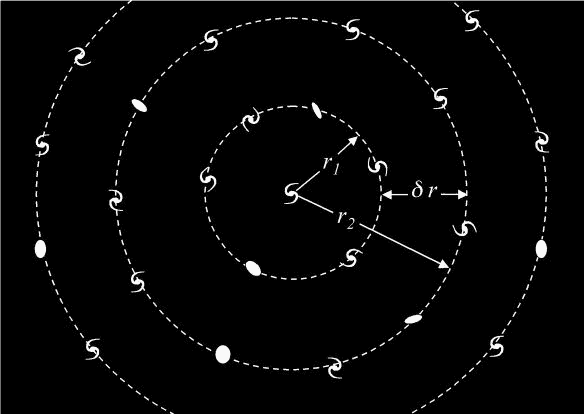 Figure 6. Galaxies tend to be grouped in concentric spherical shells around our home galaxy. The distance interval between shells is of the order of a million light years, but since several different intervals exist, the true picture is more complex than the idealization shown here. [Click image to enlarge.]
|
 Figure 7. Coordinate system used in section 6. The distance r′ is independent of the distant galaxy’s azimuth ƒ around the axis of displacement. If our galaxy were greatly displaced from the centre, the distance groupings seen from our vantage point would overlap one another and become indistinguishable. [Click image to enlarge.]
|
According to Hubble’s law, the cosmological part of the redshift, z, of each galaxy corresponds to a particular distance, r. Solving equation (1) for that distance gives
 (5)
(5)
The simplest explanation for the grouping of redshifts appears to be that the corresponding distances are grouped, as Figure 5 illustrates. Taking the derivative of equation (5) then gives us the distance interval δ r corresponding to the interval δ z between groups of redshifts:
 (6)
(6)
In terms of the ‘equivalent velocity’ interval δ v between redshift groups, the distance interval would be:
 (7)
(7)
Hubble’s first estimate of H was about 500 km/s per Megaparsec (1 parsec = 3.2616 light years), but that number rapidly diminished as astronomers recalibrated their distance scales. A few decades ago, the value of H was bouncing between 50 and 100 km/s per Mpc. The past decade of accurate space-based distance measurements seems to have tightened up the estimates to between about 70 and 80 km/s per Mpc.29 Let’s take the following value as a working estimate:
 (8)
(8)
Converting from Megaparsecs to a more familiar distance unit, H would be about 23 ± 1.5 km/s per million light years, so equation (7) becomes
 (9)
(9)
Then the two redshift intervals reported by Napier and Guthrie, 37.5 and 71.5 km/s, would correspond to two distance intervals, 1.6 and 3.1 million light years.
6. Implications of distance grouping
Except for directions obscured by the Milky Way, astronomers observe about equal numbers of galaxies in all directions from us. If a particular group of redshifts represents a group of galaxy distances clustered around an average distance r1from us, then we would expect those galaxies to be roughly equally distributed all around us on a (conceptual) spherical shell of radius r1. A second group of distances might have an average of r2= r1+ δ r, so those galaxies would tend to be on a second spherical shell a distance δ r outside the first. Figure 6 shows such an arrangement of galaxies.30
Now I want to show that we could see such a grouping of distances only if we are less than about 1 million light years away from the centre of such a pattern. Imagine that our galaxy is displaced a distance a from the centre, as Figure 7 shows. According to the law of cosines, the distance r′ from our galaxy to another galaxy would be:
 (10)
(10)
where r is the distance of the other galaxy from the centre, and θ; is its colatitude, the angle from the displacement axis as seen from the centre. The distance r´ is independent of the azimuth φ (measured around the displacement axis, between 0 and 2π radians) of the faraway galaxy. So despite the absence of the third coordinate, this analysis is valid in three dimensions. When a is much less than r, equation (10) reduces to a simple approximation:
 (11)
(11)
Since the colatitude θ; for a galaxy can vary randomly from 0 to π radians, the value of r′for any given shell of radius r should vary between r - a and r + a. If a were too large, this would smear out the redshift groups, blurring the distinction between them. A simple statistical analysis31 shows that the standard deviation σθ; of the angle-dependent part of the distribution of r′is:
 (12)
(12)
The value of the radius r of a galaxy in any given shell also has a statistical distribution having a standard deviation σr, indicating the thickness of each shell. Then, according to statistics,32 the total standard deviation σ of the distribution of r´is:
 (13)
(13)
The redshift groups would overlap and become indistinguishable if σ were significantly larger than the spacing between shells, δ r. Even if σr were zero, the groups would be indistinguishable if σθ; were greater than δ r.
Figure 8 illustrates this smearing. It shows a computer simulation of distance groups, first seen from the exact centre, and then from a viewpoint 2 million light years away from the centre. I chose σ to be rather small so the peaks would be easily visible. Notice that the displacement from centre fills in the valleys and levels the peaks, making it difficult to distinguish the groups from statistical fluctuations.
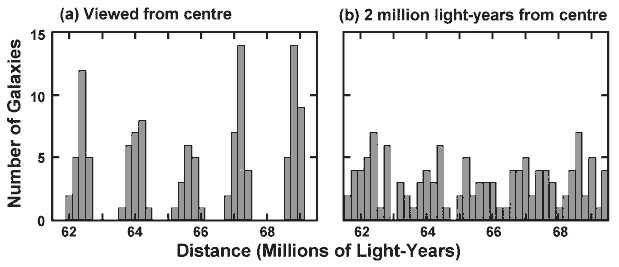 Figure 8. Computer-simulated effect of our viewpoint on galaxy distance groups. (a) Simulated groups having a radial standard deviation of 0.1 million light years and a radial spacing of 1.6 million light-years. (b) The same groups seen from a place 2 million light-years away from the centre. The highs and lows in (b) are about what statistical fluctuation in the small number of galaxies per group would produce, so the real groups have become indistinguishable from the noise. [Click image to enlarge.]
|
This means that to observe distinct groups of redshifts, we must be near the centre of the spherical-shell pattern of galaxies. According to equation (13) and the reasoning after it, our displacement a from the centre would have to be significantly smaller than the smallest observed δ r:
 (14)
(14)
Thus our home galaxy must be closer to the centre than the interval δ rthat section 5 cites, 1.6 million light years. Using the smallest observed interval33 would put us even closer to the centre—within about 100,000 light years, the diameter of our galaxy.
The probability P that we would be located in such a unique position in the cosmos by chance would be the ratio of the volumes involved,
 (15)
(15)
where R is the minimum radius of the cosmos estimated by observation, say about 20 billion light years. Using δ r = 1.6 million light years gives a value for P less than 5.12 × 10⁻¹³. That is, the probability of our galaxy being so close to the centre of the cosmos by accident is less than one out of a trillion.
In summary, the observed redshift quantizations strongly imply that the universe has a centre, and that our galaxy is uncannily close to it!
7. The cosmos is galactocentric
To name this idea, let’s elevate the word ‘galactocentric’ above its humble use in section 4, which was merely to describe a frame of reference. Let’s use the word to describe the universe itself. That is, we live in a galactocentric cosmos—auniverse that has a unique geometric centre very near our own home galaxy, the Milky Way.
As I mentioned at the end of section 4, the cosmic microwave background (CMB) data suggest that our galaxy is moving with respect to the centre of the universe.34 Our galaxy is essentially at the centre of the cosmos, but not at rest with respect to it. This differs from geocentrism, which would have the Earth be at the exact centre and motionless with respect to it.35,36 Several creationists have proposed galactocentric cosmologies.37
The technical literature of astronomy almost completely ignores a galactocentric cosmos as a possible explanation for redshift quantization.38 Instead, secular astronomers appear to prefer some as-yet-unexplained microscopic phenomenon affecting the light itself, either in its emission from atoms or its transmission through space. Tifft himself actively promotes such an explanation. Invoking a new concept, ‘three-dimensional time’, Tifft says,
‘The redshift has imprinted on it a pattern that appears to have its origin in microscopic quantum physics, yet it carries this imprint across cosmological boundaries.’ 39
Thus secular astronomers have avoided the simple explanation, most not even mentioning it as a possibility. Instead, they have grasped at a straw they would normally disdain, by invoking mysterious unknown physics. I suggest that they are avoiding the obvious because galactocentricity brings into question their deepest worldviews. This issue cuts right to the heart of the big bang theory—its naturalistic evolutionist presuppositions.
8. The big bang can’t tolerate a centre
Few people realize how different the big bang cosmology is from their conceptions of it. The misleading popular name of the theory causes most people to picture a small three-dimensional ball—having a centre and an outer edge—exploding outward into an empty three-dimensional space. After millions of years, the matter would coalesce into stars and galaxies. The whole group of billions of galaxies would constitute an ‘island’ (or archipelago) in a ‘sea’ of otherwise empty space. Like the public’s three-dimensional initial ball, such an island would have a unique geometric centre. By ‘centre’ I mean nothing esoteric, but simply the dictionary definition:
‘Centre … 1. A point equidistant or at the average distance from all points on the sides or outer boundaries of something.’40
Most people, including most scientists and even many astronomers, picture the big bang that way. But expert cosmologists picture the big bang theory entirely differently! They reject both a three-dimensional initial ball and an ‘island’ universe. In the ‘closed’ big bang (the most favored version), they imagine—purely by analogy—the three-dimensional space we can see as being merely the surface of a four-dimensional ‘balloon’ expanding out into a ‘hyperspace’ of four spatial dimensions (none is time).41 See Figure 9.
 Figure 9. Cosmologists imagine the big bang theory by means of an analogy to an expanding balloon. The analogy confines the three space dimensions we can see to merely the 3-D surface of the 4-D balloon. The galaxies would be like dust on the surface, spreading apart with the expansion. In this scheme, no galaxy could claim to be the unique centre. The true centre of the expansion would be in the region within the balloon, a region the inhabitants of the surface cannot perceive. [Click image to enlarge.]
|
They picture the galaxies like grains of dust all over the surface of the balloon. (No galaxies would be inside the balloon.) As the expansion proceeds, the rubber (representing the ‘fabric’ of space itself) stretches outward. This spreads the dust apart. From the viewpoint of each grain, the others move away from it, but no grain can claim to be the unique centre of the expansion. On the surface of the balloon, there is no centre. The true centre of the expansion would be in the air inside the balloon, which represents ‘hyperspace’, beyond the perception of creatures confined to the 3-D ‘surface’.
If you are having trouble understanding this analogy, try viewing the video version of Starlight and Time.42 Its computer-generated animated graphics have helped many people understand the analogy, walking them through it step by step.
Here’s another way to look at the expert cosmologists’ concept. If you could travel infinitely fast in any particular direction available to us, they claim you would never encounter any large volume of space unpopulated with galaxies. You would not be able to define an ‘edge’ or boundary around the galaxies, and so you could not define a geometric centre. One cosmologist says this about the popular ‘island universe’ misconception:
‘This is wrong … [The big bang cosmos] has no centre and edge.’43
So the big bang has no centre. No unique centre would exist anywhere within the three space dimensions we can see. This explains why its supporters reject any interpretation of redshift quantization requiring a centre. Below I show that their demand for acentricity44 stems from an arbitrary presupposition not justified by observations.
9. The big bang presupposition
In their influential but highly technical book, The Large Scale Structure of Space-Time, Stephen Hawking and George Ellis introduce their section on the big bang cosmology with the following general remarks:
‘However we are not able to make cosmological models without some admixture of ideology. In the earliest cosmologies, man placed himself in a commanding position at the centre of the universe. Since the time of Copernicus we have been steadily demoted to a medium sized planet going round a medium sized star on the outer edge of a fairly average galaxy, which is itself simply one of a local group of galaxies. Indeed we are now so democratic that we would not claim that our position in space is specially distinguished in any way. We shall, following Bondi (1960), call this assumption the Copernican principle’ [emphasis added].45
This notion used to be called the ‘Cosmological principle’.46,47 Note carefully that Hawking and Ellis call it an ‘assumption’ and an ‘admixture of ideology’—a presupposed idea not required by observations. Their phrase ‘we would not claim …’ is actually a dogmatic claim: the Earth is not in a special position in the cosmos. They go on to say:
‘A reasonable interpretation of this somewhat vague principle is to understand it as implying that, when viewed on a suitable scale, the universe is approximately spatially homogenous’ [emphasis added].48
‘Spatially homogeneous’ means ‘uniformly spread throughout all available space’. Hawking and Ellis are claiming that at any time space is completely filled with matter-energy. There never were any large empty volumes of space, and there never will be, they say.
They make this leap of faith because observations show that the universe is isotropic or spherically symmetric around us, meaning that from our vantage point it looks much the same in all directions. Ordinarily, Hawking and Ellis point out, this would mean, ‘we are located near a very special point’49—such as the centre. That conflicts with their desire that the Earth not be in a special location, so they seek a less troubling cosmology,
‘… in which the universe is isotropic about every point in space time; so we shall interpret the Copernican principle as stating that the universe is approximately spherically symmetric about every point (since it is approximately spherically symmetric around us).’49
As they then show, cranking this rather bizarre assumption into the mathematics of general relativity results in the various forms of the big bang theory.
10. The heart of the big bang is atheism
Let’s delve into the motive for the presupposition. Why should big bang theorists go to all this trouble to contrive a cosmology in which the Earth is not in a special place? Astrophysicist Richard Gott, in the introduction to an article specifically devoted to the Copernican principle, unveils the reason:
‘The Copernican revolution taught us that it was a mistake to assume, without sufficient reason, that we occupy a privileged position in the Universe. Darwin showed that, in terms of origin, we are not privileged above other species. Our position around an ordinary star in an ordinary galaxy in an ordinary supercluster [the local group of galaxies] continues to look less and less special. The idea that we are not located in a special spatial location has been crucial in cosmology, leading directly to the [big bang theory]. In astronomy the Copernican principle works because, of all the places for intelligent observers to be, there are by definition only a few special places and many nonspecial places, so you are likely to be in a nonspecial place’ [emphasis mine].50
The word ‘likely’ above reveals a lot. Richard Gott evidently believes we are where we are by accident! It apparently doesn’t enter his head that an intelligent Designer, God, might have placed us in a special position in the cosmos on purpose. Thus the ultimate motive behind the Copernican principle is atheistic naturalism. Since that is the driving philosophy behind naturalistic evolutionism, Gott’s reference to Darwin is appropriate. The big bang and Darwinism are two halves, physical and biological, of an atheistic origins myth.
Thus, Christians who support the big bang theory should realize that they are unwittingly denying their God and compromising with a godless worldview.
11. Scientific implications of a centre
If God used processes as part of His making the stars and galaxies on the fourth day of Creation, then redshift quantizations are evidence that some of the processes were spherically symmetric around our galaxy. For example, we could imagine spherical shock waves bouncing back and forth between the centre and edge of an expanding ball of gas or plasma, such as in the tentative cosmogony I outline in Starlight and Time.51
The reverberating waves would interfere with each other at some radii and enhance each other at other radii, setting up a pattern of ‘standing waves’, concentric shells of denser gas. God would then gather the gas into stars and galaxies. The resulting concentric patterns of galaxies would be complex, having many spacings corresponding to the many different modes of reverberation. Perhaps significantly, the principal shell spacing we observe, δr= 3.1 million light years, is of the same order as the average distance between galaxies, 12 million light years.52
Standing waves imply the matter had an outer edge for the shock waves to rebound from. That would make the geometric centre be a centre of mass also. If we put those boundary conditions (an edge and centre) into Einstein’s equations of general relativity, we get the cosmology I presented in Starlight and Time. The centre of mass is a centre for gravitational forces, low in intensity but cosmic in extent. Then gravity causes large time dilation effects at the centre during one particular stage of the expansion.
Thus quantized redshifts are observational evidence for my cosmology, bearing out my preliminary claim in 1994:
‘In particular, the “quantized” distribution of galactic red shifts,3,22observed by various astronomers seems to contradict the Copernican principle and all cosmologies founded on it— including the big bang. But the effect seems to have a ready explanation in terms of my new non-Copernican “white hole” cosmology.’53
12. Spiritual implications of a centre
To Christians, the thought of being located at the centre of the cosmos seems intuitively satisfying. But to secularists, it is deeply disturbing. For centuries they have tried to push the Copernican revolution54 yet further to get away from centrality. Carl Sagan devoted an entire book in this style to belittle our location and us:
‘The Earth is a very small stage in a vast cosmic arena … Our posturings, our imagined self-importance, the delusion that we have some privileged position in the Universe, are challenged by this point of pale light [an image of Earth taken by Voyager I]. Our planet is a lonely speck in the great enveloping cosmic dark. In our obscurity, in all this vastness, there is no hint that help will come from elsewhere to save us from ourselves.’55
Let’s consider more closely why the central position of mankind in the cosmos is so important an idea that the enemies of God try to escape it.
First, the Bible declares the uniqueness and centrality of our home planet. It mentions the Earth first in Genesis 1:1, on Day 1—long before it mentions the Sun, Moon and stars over a dozen verses later, on the fourth day. Genesis 1:6-10 locates the Earth ‘in the midst’ of all the matter of the cosmos, as I explained in Starlight and Time.56 In Genesis 1:14–15, God says the host of the heavens exists for the benefit of those on the Earth. So it is not man who imagines himself ‘at a commanding position at the centre of the universe’,57 but God who says we are there. It is heartening to see the evidence once again supporting what Scripture says.
‘Okay,’ you might say, ‘but then why didn’t God put us right at the centre of our galaxy, where the centrality would have been more evident?’ Well, it looks like He had something better in mind. First, there are good design features about our Sun’s position in the Milky way, making it an ideal environment.58,59 The inner galaxy is very active, with many supernovæ, and probably a massive black hole, that produce intense radiation.60 Instead, the Sun has a fairly circular orbit keeping the Earth at a fair distance from the dangerous central portion. In fact, the Sun is at an optimal distance from the galactic centre, called the co-rotation radius. Only here does a star’s orbital speed match that of the spiral arms—otherwise, the Sun would cross the arms too often and be exposed to other supernovæ. Another design feature is that the Sun orbits almost parallel to the galactic plane—otherwise, crossing this plane could be disruptive.
Second, there are aesthetic and spiritual reasons. If God had placed the Sun closer to the Milky Way centre, the thick clouds of stars, dust, and gas (quite aside from the supernovæ!) near our galaxy’s centre would have prevented us from seeing more than a few light years into the cosmos. Instead, God put us in an optimal position, not at the outmost rim where the Milky Way would be dim, but far enough out to see clearly into the heights of the heavens. That helps us to appreciate the greatness of God’s ways and thoughts, as Isaiah 55:9 points out.
Most important, it is very encouraging to see evidence for the centrality of humans to the plan of God. It was a sin on this planet that subjected the entire universe to groaning and travailing (Romans 8:22). Ours is the planet where the Second Person of the Trinity took on the (human) nature of one of His creatures to redeem not only us, but also the entire cosmos (Romans 8:21). This knowledge that God gave minuscule mankind prime real estate in a vast cosmos astounds and awes us, as Psalm 8:3-4 says:
‘When I consider your heavens, the work of your fingers, the moon and the stars, which you have ordained; What is man, that you are mindful of him? and the son of man, that you visit him?’
Acknowledgements
Here I want to acknowledge the valuable comments of many creationists, including those of many creationist friends in New Mexico with whom I meet regularly.
References
- Scheiner, J., On the spectrum of the great nebula in Andromeda, Astrophysical J. 9:149–150, 1899. Return to text.
- Slipher, V., The radial velocity of the Andromeda nebula, Lowell Observatory Bulletin No. 58, 1914. Return to text.
- Stromberg, G., Analysis of radial velocities of globular clusters and non-galactic nebulae, Astrophysical J. 61(5):353–362, 1925. Return to text.
- Hubble, E., A relation between distance and radial velocity among extra-galactic nebulae, Proc. Nat. Acad. Sci. USA 15:168–173, 1929. Return to text.
- Rindler, W., Essential Relativity: Special, General, and Cosmological, Revised 2nd edition, Springer-Verlag, New York, p. 213, 1977. Return to text.
- Harrison, E.R., Cosmology: the Science of the Universe, Cambridge University Press, Cambridge, UK, p. 245, 1981. Return to text.
- Mould, J.R. et al., The velocity field of clusters of galaxies within 100 Megaparsecs. I. Southern clusters, Astrophysical J. 383:467–486, 1991. See their Fig. 8 on p. 480. For other data supporting the Hubble law, see Ref. 8, pp. 82–93. Return to text.
- Peebles, P.J.E., Principles of Physical Cosmology, Princeton University Press, Princeton, p. 25, 1993. Return to text.
- Zwicky, F., On the red shift of spectral lines through interstellar space, Proc. Nat. Acad. Sci. USA 15:773–779, 1929. This was the first ‘tired light’ theory, suggesting a way photons could lose energy (and therefore increase in wavelength) in their long journey through space. Neither this theory nor its many successors ever became sufficiently persuasive to prevail. Return to text.
- Norman, T. and Setterfield, B., The Atomic Constants, Light, and Time, SRI International Invited Research Report, Menlo Park, CA, 1986. This monograph proposed that a decreasing speed of light could cause the redshifts. Return to text.
- Humphreys, D.R., C decay and galactic red-shifts, Journal of Creation 6(1):74–79, 1992. I pointed out that if we apply Setterfield’s theory (Ref. 10) consistently, the atoms would emit light with a blue shift that would exactly cancel the redshift the light would suffer in transit. As far as I know, Setterfield never disagreed. Return to text.
- Arp, H., Seeing Red: Redshifts, Cosmology, and Academic Science, Apeiron Press, Montreal, 1998. Arp shows examples of high redshift objects, often quasars, which appear to be physically connected (therefore near) to medium redshift objects, often galaxies. He suggests that additional causes of redshift besides expansion give the quasars more total redshift than their galaxy neighbors. Thus, Arp’s observations are not evidence against the general redshift-distance trend due to expansion; see review in TJ 14(3):39–45, 46–50, 2000. Return to text.
- Gentry, R.V., Creation’s Tiny Mystery, 3rd edition [see also Fingerprints of Creation], Earth Science Associates, Knoxville, pp. 287–290, 1992. Gentry proposed that distant galaxies are in orbit around a centre near our galaxy. The orbital velocities would produce a ‘transverse’ Doppler shift, a redshift caused by relativistic velocity time dilation. One problem was the gravitational blue shift the light would suffer in falling toward us. He later introduced new physics to try to solve that problem in: Gentry, R.V., A new redshift interpretation,Modern Physics Letters A 12(37):2919–2925, 1997. Neither version explains how light from the galaxies could reach us within 6,000 years. However, it might be possible to modify the first version so that the gravitational time dilation that is already in it (causing the blue shifts) would become great enough to get the light to Earth in a hurry, as measured by clocks here. That would make it more interesting to creationists. Secularist astronomers reject Gentry’s theories because, like mine, they are galactocentric. Return to text.
- West, J.K., Polytropic model of the universe, CRSQ 31(2):78–88, 1994. West offers several specific examples of the first version of Gentry’s theory (Ref. 13) in which the orbital redshifts would overcome the gravitational blue shifts. Return to text.
- Humphreys, D.R., Starlight and Time, Master Books, Green Forest, p. 66, 1994. The Bible verses are: 2 Sam. 22:10, Job 9:8, 26:7, 37:18, Psalm 18:9, 104:2, 144:5, Isaiah 40:22, 42:5, 44:24, 45:12, 48:13, 51:13, Jer. 10:12, 51:15, Ezek. 1:22 and Zech. 12:1. Return to text.
- Humphreys, Ref. 15, p. 67. Return to text.
- Rindler, Ref. 5, pp. 212–214. Return to text.
- Such motions do not appear to have obliterated the shell structure I describe in sections 5 and 6. A galaxy moving 300 km/s (a typical ‘local’ velocity) would have to move in a straight line for a billion years to move 1 million light-years from its original location. The shell structure implies that the galaxies we see had not been moving more than a billion years, or that they had not moved in straight lines. Return to text.
- Tifft, W.G., Discrete states of redshift and galaxy dynamics. I. Internal motions in single galaxies, Astrophysical J. 206:38–56, 1976. This paper does not discuss the redshift quantization of groups of galaxies very clearly, referring that to an earlier paper of his in: Shakeshaft, J.R. (Ed.),IAU Symposium 58, The Formation and Dynamics of Galaxies , Reidel, Dordrecht, p. 243, 1974. In the following decade, Tifft began describing the phenomenon itself more clearly, though his theories about it remained difficult to understand. Return to text.
- Some of the peaks in the power spectra Tifft shows have widths smaller than just a few km/s. Return to text.
- Tifft, W.G. and Cocke, W.J., Global redshift quantization, Astrophysical J. 287:492–502, 1984. Return to text.
- Newman, W.I., Haynes, M.P. and Terzian, Y., Redshift data and statistical inference, Astrophysical J. 431(1/pt.1):147–155, 1994. Return to text.
- Cocke, W.J. and Tifft, W.G., Statistical procedure and the significance of periodicities in double-galaxy redshifts, Astrophysical J. 368(2):383–389, 1991. Return to text.
- Napier, W.M. and Guthrie, B.N.G., Quantized redshifts: a status report, J. Astrophysics and Astronomy 18(4):455–463, 1997. Return to text.
- Cohen et al., Redshift clustering in the Hubble deep field, Astrophysical J. 471:L5–L9, 1996. Return to text.
- Tifft, W.G., Evidence for quantized and variable redshifts in the cosmic background rest frame, Astrophysics and Space Science 244(1–2):29–56, 1996. Return to text.
- Tifft, W.G., Redshift quantization in the cosmic background rest frame, J. Astrophysics and Astronomy 18(4):415–433, 1997. Return to text.
- Scott et al.; in: Cox, A.N. (Ed.), Allen’s Astrophysical Quantities, 4th edition, Springer-Verlag, New York, pp. 658, 661, 2000. The Sun is moving 370.6 ± 0.4 km/s with respect to the cosmic microwave background (CMB), toward galactic longitude and latitude (264.°31 ± 0.°17, 48.°05 ± 0.°10), or a right ascension and declination of about (11h, 9°S). That direction is a little below the constellation Leo, in the lesser-known constellation Sextans. From data in the reference I calculate the following: (a) The Sun’s velocity with respect to our galaxy’s centre is 240 km/s toward galactic coordinates (88°, 2°), and (b) the velocity of the centre of our galaxy with respect to the CMB is 556 km/s toward galactic coordinates (266°, 29°). The latter corresponds to right ascension and declination (10h 30m, 24°S), below the constellation Hydra. The above speeds are much larger than the Earth’s average orbital velocity around the Sun, 29.79 km/s. Return to text.
- Bahcall, N.A., Ostriker, J.P., Permutter, S. and Steinhardt, P.J., The cosmic triangle: revealing the state of the universe, Science 284:1481–1488, 1999. Return to text.
- The shell structure would be on a much smaller scale than the large-scale ‘foam’ arrangement of galaxies observed in redshift surveys. That is, the shells (with million light-year spacings) would occur in the thick (scores of million light-years) ‘walls’ of galaxies between the large empty ‘bubbles’ containing no galaxies. Return to text.
- Taking θ to have a flat probability distribution, and regarding a cos θ in equation (11) as a random variable x varying from - a to + a, substitution in the integral giving the probability for a given θ shows that the probability distribution of x is (a2 – x2 )– 0.5. Integrating that distribution in the usual expression for the variance [Ref. 32, p. 57, bottom of page], and then taking the square root of the variance, gives the standard deviation given by my equation (13). Return to text.
- Bulmer, M.G., Principles of Statistics, Dover Publications, New York, p. 72, 1979. Return to text.
- The smallest δv reported by Tifft (though the data for it are less pronounced than for the larger spacings) is 2.6 km/s. Then δr shrinks to 0.12 million light-years, and P in equation (15) drops below 2.24 ´ 10-16 —less than one out of a quadrillion. Return to text.
- See Ref. 28 for various velocities in various reference frames. Return to text.
- Bouw, G.D., Geocentricity, Association for Biblical Astronomy, Cleveland, 1992. Bouw, advocating geocentrism, cites Psalm 93:1 as his foundational text. Notice in that verse that the Hebrew word translated ‘world,’ תבל tevel, can mean ‘continent(s)’, according to one lexicon: Holladay, W.L., A Concise Hebrew and Aramaic Lexicon of the Old Testament, Eerdmans, Grand Rapids, p. 386, 1971. Thus the verse could mean that, by the time the psalm was written (after the Flood), the continents would not move significantly with respect to the foundations of the Earth beneath them. Return to text.
- Faulkner, D.R., Geocentrism and Creation, TJ 15(2):110–121, 2001. This is a detailed critique of modern geocentrism. Return to text.
- Gentry, Ref. 13, and Humphreys, Ref. 15. Return to text.
- Varshni, Y.P., The red shift hypothesis for quasars: is the Earth the centre of the universe? Astrophysics and Space Science 43:3–8, 1976. Varshni shows that redshifts from 384 quasars (not galaxies) appear to be quantized into 57 groups, and that if the distance interpretation of redshifts is correct, then the ‘quasars are arranged on 57 spherical shells with Earth as the centre’. He then uses this ‘unaesthetic possibility’ to question the correctness of the redshift-distance interpretation for quasars. A brief article trying to rebut him complained that ‘the Earth would have to be in a strongly privileged position in the Universe’: Stephenson, C.B., Comment on Varshni’s recent paper on quasar red shifts,Astrophysics and Space Science 51:117–119, 1977. Varshni made a convincing rejoinder in: Varshni, Y.P., The red shift hypothesis for quasars: is the Earth the centre of the universe? II, Astrophysics and Space Science 51:121–124, 1977. Return to text.
- Even some creationists have favored non-galactocentric explanations. They do not seem to have understood why secularists resist galactocentricity, why it would be of advantage to Christians, or that it is strongly implied in Genesis 1:6. See Humphreys, Ref. 15, pp. 71– 72. Return to text.
- Soukhanov, A.H. (Ed.), Webster’s II New Riverside University Dictionary, Riverside Publishing Company, Boston, p. 242, 1984. Return to text.
- Rindler, Ref. 5, pp. 212–213. Return to text.
- DeSpain, M., Starlight and Time, Forever Productions, Albuquerque, 2001. Videotape (27 minutes) available through Answers in Genesis, the Creation Research Society, or the Institute for Creation Research. Return to text.
- Harrison, Ref. 6, p. 107. Return to text.
- Acentricity means ‘without a centre’. Big bang theorists claim that ‘Every point is a centre’, but that obscures the issue. The public and most scientists think of the word ‘centre’ as meaning the dictionary definition I gave in section 8, which implies an object can have only one centre. For the sake of clarity, big bang supporters should rephrase their claim to, ‘Every point is a point of spherical symmetry.’ Return to text.
- Hawking, S.W. and Ellis, G.F.R., The Large Scale Structure of Space-Time, Cambridge University Press, Cambridge, p. 134, 1973. Their reference is to: Bondi, H., Cosmology, Cambridge University Press, Cambridge, 1960. Return to text.
- Robertson, H.P. and Noonan, T.W., Relativity and Cosmology, W.B. Saunders Company, Philadelphia, p. 336, 1969. Return to text.
- Rindler, Ref. 5, pp. 201–203. Return to text.
- Rindler, Ref. 5, p. 134. Return to text.
- Rindler, Ref. 5, p. 135. Return to text.
- Gott, J.R. III, Implications of the Copernican principle for our future prospects, Nature 363:315–319, 1993. It is ironic that the name ‘Gott’ is the German word for ‘God’. Return to text.
- Humphreys, Ref. 15, pp. 31–38, 74–79, 122–126. Return to text.
- Scott et al., Ref. 28, p. 660, with h = 0.75. Return to text.
- Humphreys, Ref. 15, p. 128. My Ref. [3] was: Anonymous, Quantized redshifts: what’s going on here? Sky and Telescope 84(2):28–29, August, 1992. My Ref. [22] was: Guthrie, B.N.G. and Napier, W.M., Evidence for redshift periodicity in nearby galaxies, Monthly Notices of the Royal Astronomical Society 253:533–544, 1991. Return to text.
- Copernicus, N., De Revolutionibus Orbium Caelestium, Johannes Petreius, Nuremberg, Book I, Chapter 10, 1543. ‘We therefore assert that the center of the Earth, carrying the Moon’s path, passes in a great circuit among the other planets in an annual revolution around the Sun; that near the Sun is the center of the Universe; and that whereas the Sun is at rest, any apparent motion of the Sun can be better explained by motion of the Earth.’ Translation from: Kuhn, T.S., The Copernican Revolution, Harvard University Press, Cambridge, Massachusetts, p. 179, 1957. I agree with Copernicus that the universe has a centre, and that the Earth is neither exactly at it nor motionless with respect to it. The CMB data (Ref. 28) disagree with his implication that the Sun is motionless with respect to the centre. Big bang supporters are ‘hyper-Copernican’, trying to eliminate a centre altogether. Return to text.
- Sagan, C., Pale Blue Dot: A Vision of the Human Future in Space, Ballantine Books, New York, p. 9, 1977. The alleged insignificance of Earth is a major theme of Sagan’s book. See also the quotes by Hawking and Ellis in section 9, and by Richard Gott in section 10. Return to text.
- Humphreys, Ref. 15, pp. 68–72. Return to text.
- Hawking and Ellis, Ref. 45, p. 134. See quote at the beginning of my section 9. Return to text.
- Sarfati, J., The Sun: our special star, Creation 22(1):27–30, 1999. Return to text.
- Chown, M., What a star! New Scientist 162(2192):17, 1999. Return to text.
- Morris, M., What’s happening at the centre of our galaxy? Physics World (October 1994) pp. 37–43, 1994. Return to text.


Readers’ comments
Comments are automatically closed 14 days after publication.