

Journal of Creation 12(3):339–346, December 1998
Browse our latest digital issue Subscribe
Live plesiosaurs: weighing the evidence
Summary
The wealth of fossilized plesiosaur skeletons testify that these creatures roamed the waters of the past. Recent finds of plesiosaur-like carcasses, on the other hand, have been controversial. Of all plesiosaur-like creatures washed up on shores around the world, basking sharks account for over 90%. The conclusion of the Japanese study published in 1978 on the 1977 Zuiyo-maru carcass trawled off the New Zealand coast, clearly supports identification as a shark. There is evidence, however, for live plesiosaurs in recent times.
Introduction
From its find in 1977, the Zuiyo-maru carcass has been the source of controversy. A thorough Japanese report was published in 1978, but confusion about the observations and conclusion of this study still remains today. This is evident from the varied opinions in the many books1–6 articles and reviews,7–10 and letters to editors11–15 relating this find. Controversies surrounding sea creature finds, and more specifically plesiosaur-related ones, are nothing new, however, as they have raged long before the famous Japanese find (see below). I believe this article is needed to help sort out the confusion in creationist circles concerning the validity of plesiosaur finds, especially the 1977 carcass, as most have not had the opportunity (as I had not) to study all the relevant information systematically.
In this article I will provide some pertinent background information, a summary on the most salient points from the published study in 1978, followed by a few independent conclusions from the available data, and then finally my conclusion to the whole issue.
Plesiosaur evidence

The past existence of plesiosaurs is evident from the wealth of fossilized skeletal remains unearthed worldwide. From the skeletons and from our knowledge of structure and function of various body types from presently living animals, these creatures have been reconstructed, to give us an idea of their appearance and how they may have lived.
Plesiosaurs were marine dwelling reptiles, and based on skeletons found to date they ranged in size from more than 2 meters (7 feet) for Plesiosaurus to about 14 meters (46 feet) for Elasmosaurus.16, 17
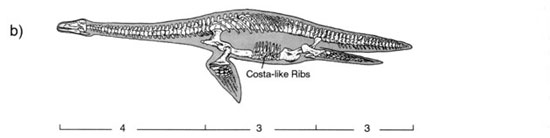
The order Plesiosauria has been divided into two Superfamilies16: Plesiosauroidea, such as Cryptoclidus (sometimes spelt Cryptocleidus, Figures 1, 2b), characterized by long necks, with 28–71 vertebrae, and small heads, and Pliosauroidea, whose members had large heads and short necks with as few as 13 vertebrae. A huge pliosaur was Kronosaurus (Fig. 2a), whose skull alone was 2.4 meters (8 feet) long.
Plesiosaurs possessed deep bodies and flipper-like limbs unique among marine reptiles, ending in phalanges consisting of five to ten bones (see Figure 1, 2b). The flippers, shaped like hydrofoils, were moved in large vertical strokes enabling the ‘subaqueous flight’ swimming style similar to sea turtles and penguins. The bones of the pectoral and pelvic girdles formed broad plates on the underside of the body to where the limbs and powerful swimming muscles were attached. A number of dense ventral, costa-like ribs connected the two plates, providing a strong, rigid base for the movement of the flippers (Figure 2a). It is also believed that plesiosaurs crawled on to beaches to lay their eggs in a similar manner to turtles, the rigid base providing the necessary support and protection.16,17
According to evolutionary dating methods they are believed to have lived in the Mesozoic Era, approximately 230–65 million years ago.
According to Dixon et al.,16
‘Plesiosaurs seem to have changed little during their 135 million years of evolution. The earliest member of the group, Plesiosaurus, had already developed all the main structural features that characterize these marine reptiles … The pliosaurs first appeared in the Early Jurassic, alongside their ancestors, the plesiosauroids.’
So it appears that the fossil record supports creation of the plesiosaur type and variation within the kind. In Genesis 1:20–23, however, we read that plesiosaurs were created with the rest of the sea creatures on Day 5 of Creation Week:
‘And God said, Let the waters bring forth abundantly the moving creature that hath life, and fowl that may fly above the earth in the open firmament of heaven.
‘And God created great whales, and every living creature that moveth, which the waters brought forth abundantly, after their kind, and every winged fowl after his kind: and God saw that it was good.
‘And God blessed them, saying, be fruitful, and multiply, and fill the waters in the seas, and let fowl multiply in the earth.
‘And the evening and the morning were the fifth day.’
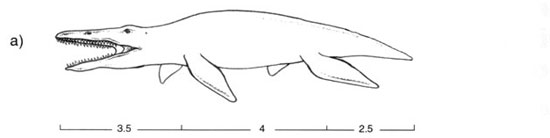

a) Kronosaurus.
b) Reconstructed Cryptoclidus skeleton (after Norman17).
c) Basking shark with inset ‘pseudoplesiosaur’ (after Kuban, ref. 10).
d) Sketch and proportions of the Zuiyo-maru carcass by Michihiko Yano. The sketch was made from memory, after the carcass had been discarded, and the bones were Yano’s interpolations. Note that the carcass proportions were wrongly portrayed in Yano’s drawing (from Collected Papers on the Carcass of an Unidentified Animal trawled off New Zealand by the Zuiyo-maru, 1978).
Documented history of sea carcasses
But are plesiosaurs alive today, or did they become extinct? Many cases of ‘sea creatures’ being washed up on seashores are documented around the world. In a lot of these instances the media hype, preconceived ideas and people’s fascination with monsters have coloured the rational interpretation of the carcasses.
One of the earliest reports regards the carcass of a sea animal with a long neck washed ashore at Stronsay Island in the Orkneys, Scotland. Eyewitnesses described the creature as having 6 legs and a mane covering the body. It became known as the ‘Stronsay beast.’ Fortunately, some pieces of the animal were kept, including the skull and a number of vertebrae. In 1933, upon study of the vertebrae, it was clear that they were from a shark. The vertebrae are held at the Royal Museum of Scotland. A sketch by the eyewitness, illustrating the cranium, vertebrae and pelvic skeleton, also confirm that it was the remains of a shark.18
Many additional documented cases of plesiosaur-like creatures have received a lot of media attention, and apparently basking sharks account for over 90% of all such reported sea serpents.19 Some of the cases which have been positively identified as a shark, and most probably a basking shark are:5
-
in 1934 at the beach of Querverille, on the Channel coast of France;
-
in 1937 at a beach near Princetown, Cape Cod, USA;20
-
in 1941 on the Scottish shores of Hunda and Deepdale Holm;
-
in 1970 ashore at Scituate, Massachusetts, USA, and;
-
in 1977 at Nemura Hokkaido, Japan (see below).21
Other cases where the description fits that of a basking shark:21,22
-
in 1948 on Dunk Island, Queensland, Australia;
-
in 1953 at Girvan on the Firth of Clyde, Scotland, and;
-
in 1960 on the beach at Temma, Tasmania, Australia.
Basking Sharks
The basking shark, Cetorhinus maximus is only second in size to the whale shark. Individuals have been known to reach up to more than 13.7 meters (45 feet) long.23
The gill arches are very large, extending around the neck and almost meeting at the throat. The fifth pair of gill arches is just in front of the pectoral fins (Figure 2b). Basking sharks sometimes swim on the surface of the water with mouth wide open, filtering out plankton, or more often just sun themselves on the surface with the dorsal fins towering out of the water. They are also known to congregate in loose schools and to swim one behind the other, which could give the appearance of a ‘sea serpent.’
When the shark decays, the tissue around the gills breaks apart, so the gills and the lower jaw fall off. This leaves the spinal column and the cranium to resemble a long neck and a small head (Figure 2c). As the bottom of the tail fin has no spinal column, it also decays leaving the appearance of a long tail. Finally the skin sloughs away and the muscles fray out resulting in what resembles a hairy mane. Carcasses have a distinctive plesiosaur appearance, and have been termed ‘pseudoplesiosaurs.’24 The pair of claspers (copulatory appendages) of male sharks may give the appearance of an extra pair of limbs, like that reported for the ‘Stronsay beast’ find. However, when further decayed, they partly merge with the closely associated pelvic fins, making the fins appear larger (see Figure 2c).

Top: front view of the carcass. This picture mainly inspired the plesiosaur identification.
Bottom left: rear view of carcass.
Bottom right: carcass lying on deck.
The Zuiyo-maru carcass
On April 25, 1977, a carcass was netted off the coast of New Zealand, about 30 miles east of Christchurch, by the Japanese trawler Zuiyo-maru.25 It weighed a hefty 4000 pounds and was 10 meters (33 feet) long. Michiko Yano, the assistant production manager aboard the Zuiyo-maru took five photographs of the carcass and some measurements, and removed forty-two pieces of horny fibre from one of the anterior fins (see Figures 3a, 3b and 3c).26
The fibres were washed to remove the putrid smell, treated with antiseptic solution containing 0.04% sodium hypochlorite (NaClO) for 12 hours, and allowed to air dry.27 A sketch of the carcass was later made ‘based solely on Yano’s imagination’28 after it had been thrown away, but it conflicted with Yano’s original measurements (see Figure 2d). The bone shown in the appendages was determined merely by kicking them and standing on them.28
Yano’s photographs and his misleading sketch were presented by the Taiyo Fishery at a press interview. Great media hype erupted about the find,
‘ … a few newspapers published very sensational stories … speculating its identity as a giant shark, plesiosaur, Nessie, or other monsters … Radio and television were no less enthusiastic … Every variety of speculations [sic], each quoting, in various ways, comments of scientists … ’25
In the Asahi Shimbun newspaper Professor Yoshinori Imaizumi of Japan’s National Science Museum was quoted as stating,
‘ … It’s a reptile, and the sketch looks very like a plesiosaur. This was a precious and important discovery for human beings. It seems to show that these animals are not extinct after all.’26
The plesiosaur stamp
In November 1997, a stamp (the well–known plesiosaur stamp) was issued commemorating the centenary of the Tokyo National Science Museum (see Figure 4). This stamp has also been a source of confusion and speculation. Some have used it as proof for the find being a plesiosaur,2,7 while others are convinced that the stamp had nothing to do with the creature,9,11,26 or that the carcass may have had some influence on the plesiosaur choice for the stamp.15 The plesiosaur was probably a general reconstruction modeled by the museum.29

|
National Science Museum
|
|
Figure 4: First Day of Issue cover and, at right, the (very loose) English translation provided on the accompanying card for the ‘plesiosaur’ stamp. When the Japanese text (not shown) under the heading ‘Design’ was translated, it read: ‘Bone structure and National Science Museum.’ (Cover and information supplied by Jang.)29 |
|
It is difficult, though, to escape the feeling that a combination of media hype, the view held by some in the scientific community based on Yano’s misleading sketch, and the lack of a thorough analysis of the evidence (an ambiguous interim report was given on July 25 based on chemical analysis of the horny fibre), strongly influenced the design of the stamp.
The scientific report
In order to settle the reigning confusion concerning the true identity of the monster, Dr Tadayoshi Sasaki, president of Tokyo University of Fisheries, arranged for a group of scientists from various fields to carry out a thorough investigation of the available evidence. Their results were published in January 1978 by La Société Franco–Japonaise d’Océanographie as a collection of nine papers.25
The majority of the findings clearly indicated that the carcass was a decaying basking shark. Below are the most important observations from each study (some shared observations are only mentioned under one research group).
Obata and Tomoda:30
-
‘ … the anterior limb or fin appears to be articulated at a right angle to the shoulder. Such state of articulation is indicative of a shark’ (see Figure 3a).
-
Lack of neural spine is consistent with selachians (a group of vertebrates which includes sharks and rays).
-
‘The number of cervical vertebrae indicated by Yano is too small for a plesiosaur … the neck part is not necessarily inconsistent with that of a shark.’ (Even the short necked pliosaurs had at least 13 neck vertebrae compared to seven described by Yano: see Figure 2d.)
-
‘If the unidentified animal were a plesiosaur, it would have paired fins with the characteristic five rows of phalanges. But phalanges were not observed in the carcass … horny fibre of the fins is found only in selachians but not in marine reptiles.’
-
From a reconstruction of carcass based on Yano’s measurements, ‘There are no known fossil reptilian species which agree with the animal under investigation’.

Omura et al:21
-
‘ … by a close examination of the photograph we can clearly distinguish the base of dorsal fin, though it had slipped from the mid-dorsal line … ’ (see Figure 5). (Plesiosaurs do not have dorsal fins.)
-
‘There were mycomata in the dorsal muscles.’ Mycomata consist of strong connective tissue between muscle segments and are present in sharks but not in reptiles (see Figure 5).
-
‘It had pectoral and dorsal fins with fin-rays characteristic of fish.’
Hasegawa and Uyeno:31
-
‘In plesiosaurs, the bones of all the limbs exist at the ventral portion of the body. If the creature was a plesiosaur reptile, the ventral parts of the body, including the limbs would have already been detached from the backbone.’
-
‘If it were a plesiosaur, the body would not take on the bent posture as shown in the photograph, … because the breast bone is large and flat’ (Figure 3a).
-
‘Also, some sets on [sic, of] costa-like bones on the ventral side, which are located on the abdomen of plesiosaurs are absent in this creature.’
-
‘ … the head of the animal resembles that of a turtle but plesiosaurian reptiles have somewhat triangular skulls.’
-
‘At this degree of decomposition, some teeth should still be remaining on the upper jaw.’
-
‘If the degree of decomposition is advanced to the point that the front portion of the skull has fallen off, the shape of the body should be more distorted, if not destroyed.’
-
‘Yano’s measurement of the ribs was 40 cm, which is too short for ribs of any vertebrates other than cartilaginous ribs of sharks.’
-
‘From the osteological point of view, we conclude that this creature does not belong to the plesiosaurian reptiles.’
| Amino Acid | Horny fiber | Basking shark elastodin |
|---|---|---|
| 4–Hydroxyproline | 45 | 45 |
| Aspartic acid | 54 | 55 |
| Threonine | 25 | 25 |
| Serine | 39 | 40 |
| Glutamic acid | 80 | 80 |
| Proline | 130 | 125 |
| Glycine | 291 | 290 |
| Alanine | 109 | 110 |
| Cystine (1/2) | 7 | 6 |
| Valine | 25 | 24 |
| Methionine | 10 | 10 |
| Isoleucine | 20 | 20 |
| Leucine | 19 | 19 |
| Tyrosine | 43 | 41 |
| Phenylalanine | 12 | 12 |
| Hydroxylysine | 5 | 6 |
| Lysine | 25 | 26 |
| Histidine | 11 | 13 |
| Arginine | 51 | 53 |
| Table 1. Amino acid composition of horny fiber from the 1977 Zuiyo-maru carcass and basking shark elastoidin after NaClO treatment. Shown as residues/1000 residues (after Kimura et al.27). | ||
Kimura et al: 32
-
The horny fibres were characteristic of basking shark elastoidin, a collagenous protein only found in sharks but not in other fish or reptiles, in:
-
hydrothermal behaviour (shrinkage temperature of 63°C compared to 65°C for elastoidin);
-
450–500 Å periodic striation of the fibres, and;
-
similarity in amino acid composition and very low difference index, i.e. ‘43 tyrosine residues/1000 amino acid residues compared to 5 residues or less/1000 residues for collagens’ (see Table 1).
-
-
The difference in reducible cross-links, ‘which are polyfunctional amino acids derived from lysine, hydroxylysine, and or histidine residues,’ was probably due to decomposition or to destruction from treatment with a too high concentration of NaClO by Yano.
Abe:33
-
Shark-fin processors identified the fibres as ceratotrichia from basking shark fins.
-
Dried ceratotrichia from basking sharks supplied by the Department of Science, Asahi Press, Tokyo, and the isolated fibres showed remarkable resemblance.
Shark inconsistencies
A few supposed inconsistencies with the shark identification were also noted.28 These, however, have easily been accounted for. The major ones are discussed here.
-
‘The surface of the body was whitish and covered by dermal fibers which intersecting [sic] each other like in whales and other mammals but were not weak as in fish.’ Fraying of muscle to give the appearance of a bristly or hairy mane is characteristic of basking shark decomposition (see above).
-
‘The thick fat tissues and the reddish muscles beneath them … suggest that the unidentified animal shared a fundamental body plan with tetrapods.’ However, basking sharks are known to have large fat deposits in their white muscles.34 Adipocere (a waxy substance produced by saponification of carcass fat) from muscles is mostly white to gray in colour, and readily occurs in salt water. Adipocere is rendered insoluble by ammonia from the sharks’ muscles.35 Reddish muscle is not only found in tetrapods but also in some sharks.34,36
-
‘The putrefactive smell was not like that of teleostean fishes or sharks, but resembles that of marine mammals.’ The lack of the characteristic ammonia smell of sharks could be due to the ammonia leaching out (ammonia is extremely soluble in water) because of the extent of skin loss and decomposition.31 Also, adipocere ‘emits a smell like cheese or mold,’37 and live basking sharks are known to emit an offensive odour.34
-
Pectoral and pelvic fins appeared to be the same size. But in male sharks a set of large claspers are closely associated with the pelvic fins and could give them a larger appearance (see Figure 2b).36
Summary of scientific findings on Zuiyo-maru carcass
The conclusion of the research teams can be summarized with the quote,
‘General opinion favours identification as a shark. A possible method to approach a more accurate identification may be to focus on the basking shark.’38

At the beginning of September 1977, less then two months after the Zuiyo-maru capture story was released to the press, a 5-meter (16 feet) carcass was found stranded at Nemuro, Hokkaido. More decomposed than the Zuiyo-maru carcass, it had lost most of the muscles, and the vertebrae were clearly exposed. The gill-arches and the lower jaw were also missing leaving a turtle-like cranium. The vertebral column was complete and the pectoral and pelvic fins were still attached, but their apices were damaged. This carcass, however, was accepted as belonging to a basking shark.38
It is clear that if the scientific report had first been published and widely documented prior to the release of the photographs and Yano’s misleading sketch of the creature, more sanity would have prevailed at the time, even in scientific circles. And there would also be less controversy today.
Another pseudoplesiosaur from New Zealand
In August 1996 Mrs Bev Elliott, of Kaikoura, New Zealand, found a carcass on the beach south of Kaikoura (see Figure 6). Mrs Elliott, a Seacare member responsible for a 20 kilometer (12 mile) stretch of beach, who had ardently believed that the Zuiyo-maru carcass was a plesiosaur, was initially thrilled to find her own dead plesiosaur. But on closer examination of the carcass it was clear that it was a basking shark.39 The carcass was 18 paces long (approximately 10 meters (33 feet)), had a thin neck and tail, and a small head, but no fins, as a result of its late stage of decomposition. When she compared the carcass with that from Yano (see Figures 3a and 3b) she noted,
‘Apart from not being able to see any flippers on my carcass, they’re practically twins.’40
Her Seacare leader also related that a basking shark had recently been caught in a net by local fishermen and the skeleton was cartilage and not bone. Was this the carcass that Bev found?
Live plesiosaurs today?
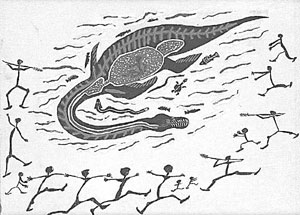
There are many stories and legends of dragons, with descriptions fitting dinosaurs, supporting that man and dinosaur did in fact live together (supporting also a young age for earth).7 Australian Aboriginal folklore abounds with such stories,42 including references to plesiosaur-like creatures. Elders of the Kuku Yalanji Aboriginal tribe of Far North Queensland, Australia, relate stories of Yarru (or Yarrba), a creature which used to inhabit rainforest waterholes.43 The painting in Figure 7 depicts a creature with features remarkably similar to a plesiosaur (compare with Figures 1 and 2a). It even shows an outline of the gastro-intestinal tract, indicating that these animals had been hunted and butchered.
A picture of a plesiosaur, dubbed the Bynoe Harbour Monster, appeared recently in a Darwin newspaper after occasional sightings by fishermen. A Christian Anyuna native from the Northern Territory familiar with many of his tribe’s songs, or ‘kudjika,’ after seeing the picture in the newspaper realized that one of these kudjikas described the neck, limbs and body of a plesiosaur.44
It would not surprise me at all if a live plesiosaur was found today.
Conclusion
The theistic evolutionist and anti-creationist Kuban has extensively reviewed the Zuiyo-maru find.41 In one of his statements, however, he shows the fallacy of evolutionary thinking,
‘However, even if a living plesiosaur were confirmed, it would not threaten the theory of evolution. After all, many other animal groups represented by modern species co-existed with the dinosaurs in the Mesozoic Era … but some creatures, such as the Coelacanth and Tautara [sic], were once thought to have been extinct for tens of millions of years, only to be later found alive and little changed in modern times. These cases emphasize the incompleteness of the fossil record and the remarkable stasis of some animal groups, but are not grounds for upheavals in evolutionary thought.’
The fossil record is indeed incomplete, but this really means that it lacks the countless transitional forms that Darwin predicted. But a thorough investigation of fossils clearly demonstrates that evolutionary metamorphosis from one animal type to another has not occurred. Instead of many transitional stages, there is only a handful of debatable ones. Many fossilized insects and animal fossils are identical to those living today.
When sin entered the world death followed, and a perfectly balanced ecosystem, based mainly on a vegetarian subsistence was destroyed. As seen today, animal and plant species are constantly dying out and there is an escalating number in the ‘endangered species’ list. The finding of a live plesiosaur would certainly be another evolutionary headache.
God has already revealed fauna and flora that were believed extinct, confounding evolutionary-atheistic thinking. We may all hope to find a live plesiosaur, and there is some evidence to support that these creatures roamed the waters in recent times (see below). But to ground our belief on spurious finds such as the Zuiyo-maru carcass, choosing to ignore the weight of evidence for decomposing sharks, is great folly. God gives unequivocal evidence in His chosen time, as is seen with the finding of live Coelacanths, Tuatara, etc. We are not ‘helping’ God and the Gospel of Jesus Christ if we are seen by unbelievers to hold on to unfounded claims ‘ … be ye therefore wise as serpents, and harmless as doves’ (Matthew 10:16).
References
Note: CPC refers to Collected Papers on the Carcass of an Unidentified Animal trawled off New Zealand by the Zuyo-maru, Edited by T. Sasaki, La Société Franco–Japonaise d’Océanographie, Tokyo, pp. 45–83, 1978.
- Taylor, P.S., The Great Dinosaur Mystery and the Bible, Chariot Books, David C. Cook Publishing Co., Elgin, Illinois, pp. 46–47, 1987. Return to text.
- Unfred, D., Dinosaurs and the Bible, Huntington House, Lafayette, Louisiana, p. 34–35, 1990. Cited in Niermann, Ref. 7, p. 102. Return to text.
- Taylor, I.T., In the Minds of Men, TFE Publishing, Toronto, pp. 106–107, 1984. Return to text.
- Heuvelmans, B., In the Wake of Sea Serpents, Hill and Wang, New York, 1968. Cited in Kuban, Ref. 10, p. 19. Return to text.
- Bright, M., There are Giants in the Sea, Roleson Books, London, pp. 180–184, 1989. Return to text.
- Shuker, K.P.N., In Search of Prehistoric Survivers, Blandford, London, pp. 98–99, 1995. Return to text.
- Niermann, D.L., Dinosaurs and Dragons, CEN Tech. J., 8(1):85–104, 1994. Return to text.
- Wood, T.C., Zuiyo-maru carcass revisited: plesiosaur or basking shark?, CRSQ 33(4):292–295, March 1997. Return to text.
- Anon., Queries and comments, Origins 21:24–25, July 1996. Return to text.
- Kuban, G.J., Sea-monster or Shark? An analysis of a supposed plesiosaur carcass netted in 1977, National Centre for Science Education, Reports 17(3):16–28, 1997. Return to text.
- Boyle, T.D., Letter to the editor, CEN Tech. J. 8(2):155, 1994. Return to text.
- Chui, C., Letter to the editor, CRSQ 34(4):252, March 1998. Return to text.
- Wood, T.C., Letter to the editor, CRSQ 34(4):252–253, March 1998. Return to text.
- Bowden, M., Letter to the editor, CRSQ 34(4):254–255, March 1998. Return to text.
- Jang, A.W., Letter to the editor, CRSQ 34(4):256–258, March 1998. Return to text.
- Dixon, D., Cox, B., Savage, R.L.G. and Gardiner, B., The Macmillan Illustrated Encyclopedia of Dinosaurs and Prehistoric Animals, Macmillan Publishing Co., New York, pp. 76–77, 1988. Return to text.
- Norman, D., The Illustrated Encyclopedia of Dinosaurs, Salamander Books Ltd., London, pp. 178–179, 1985. Return to text.
- Bright, Ref. 5, pp. 180–181. Return to text.
- Bright, Ref. 5, p. 183. Return to text.
- Bigelow and Schroeder, Fishes of the Gulf of Maine, United States Government Printing Office, 1953. See <www.mbl.edu/html/MISC/basking.html>, p. 3. Return to text.
- Omura, H, Mochizuki, K. and Kamiya, T., Identification of the carcass trawled by the Zuiyo-maru from a comparative viewpoint. In CPC, p. 59, 1978. Return to text.
- Bright, Ref. 5, pp. 182–183. Return to text.
- Bigelow and Schroeder, Ref. 20, p. 2. Return to text.
- Cohen, D., The Encyclopedia of Monsters, Dodd, Mead and company, New York, 1982. Return to text.
- Sasaki, T., Foreword. In CPC, n.p. 1978. Return to text.
- Koster, J., Creature feature, Oceans 10:56–59, November 1977. See <http://www.gennet.org/facts/nessie.html>, p. 2. Return to text.
- Kimura, S., Fujii, K., Sato, H., Seta, S. and Kubota, M., The morphology and chemical composition of horny fiber from an unidentified creature captured off the coast of New Zealand. In CPC, p. 67, 1978. Return to text.
- Obata, I. and Tomoda, Y., Comparison of the unidentified animal with fossil animals. In CPC, pp. 49, 1978. Return to text.
- Jang, A.W., Personal communication, 10 August 1998. Return to text.
- Obata, I. and Tomoda, Y., Ref. 28, pp. 45–54. Return to text.
- Hasegawa, Y. and Uyeno, T., On the nature of the carcass of a large vertebrate found off [sic, of] New Zealand. In CPC, pp. 63–66, 1978. Return to text.
- Kimura et al, Ref. 27, pp. 67–74. Return to text.
- Abe, T., What the giant carcass trawled off New Zealand suggests to an ichthyologist. In CPC, pp. 79–80, 1978. Return to text.
- Steel, R. Sharks of the World, Facts on File Publications, New York, 1985. Cited in Kuban, Ref. 10, p. 25. Return to text.
- Seta, S., On the condition of the carcass of the unidentified animal. In CPC, pp. 75–76, 1978. Return to text.
- Hasegawa and Uyeno, Ref. 31, p. 65. Return to text.
- Seta, Ref. 35, p. 76. Return to text.
- Obata and Tomoda, Ref. 28, p. 53. Return to text.
- Elliott, B., Letter to CMI ministries, 7 February 1997. Return to text.
- Elliott, B., Letter to CMI ministries, 3 March 1997. Return to text.
- Kuban, Ref. 10, p. 18. Return to text.
- Shuker, K., The Unexplained, Carlton Books, London, 1997. Return to text.
- Kuku Yalanji tribespeople, Personal communications to CMI ministries, 1998. Return to text.
- McLaughlin, Dehne, Email communication to CMI ministries, 1 December 1998. Return to text.
Readers’ comments
Comments are automatically closed 14 days after publication.