

Mokele-mbembe: a living dinosaur?
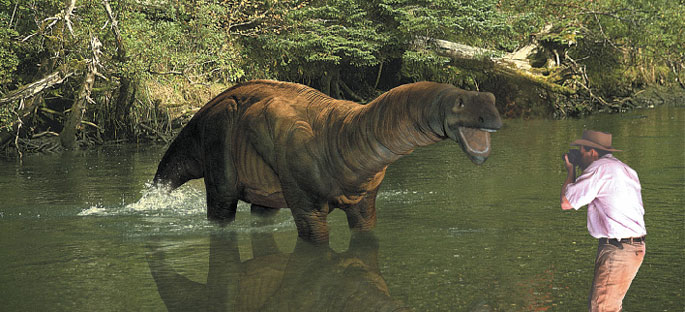
Over the past 100 years, there have been many reports of sightings, in a remote area of central Africa, of a swamp-dwelling animal known to local villagers as ‘mokele-mbembe’—the ‘blocker-of-rivers’.1,2,3,4,5,6,7 It is described as living mainly in the water, its size somewhere between that of a hippopotamus and an elephant, but with a squat body and a long neck that enables it to pluck leaves and fruit from plants near the water’s edge. The creature is said to climb the shore at daytime in search of food.8 Witnesses’ drawings show that mokele-mbembe resembles nothing recognisable as still living on Earth, but it does bear a startling likeness to a sauropod dinosaur known to us by its fossil skeletons—similar in shape to a small Apatosaurus.9
The imprints of clawed feet and other tell-tale animal trail marks in the jungle around the swamps clearly show evidence of a large, heavy creature that is not a crocodile, hippopotamus or elephant.10 Most reported sightings of mokele-mbembe itself are by local fishermen who, while fishing or travelling by dugout canoe, have unexpectedly encountered the creature. However, there have been scientific expeditions mounted specifically to find the animal in the swamps that dominate much of Congo, Gabon and Cameroon. University-trained biologist Marcellin Agnagna described what he saw on one such expedition to remote Lake Tele in 1983:
‘At approximately 2:30pm, … [we] were then able to observe a strange animal, with a wide back, a long neck, and a small head. … The animal was located at about 300 metres from the edge of the lake, and we were able to adv[a]nce about 60 metres in the shallow water, placing us at a distance of about 240 metres from the animal, which had become aware of our presence and was looking around as if to determine the source of the noise. Dinkoumbou [a local villager] continued to shout with fear. The f[r]ontal part of the animal was brown, while the back part of the neck appeared black and shone in the sunlight. The animal partly submerged, and remained visible for 20 minutes with only the neck and head above the water. It then submerged completely, … no further sighting of the animal took place. It can be said with certainty that the animal we saw was Mokele-mbembe, that it was quite alive, and, furthermore, that it is known to many inhabitants of the Likouala region [an area of swampland about the same size as Florida]. Its total length from head to back visible above the waterline was estimated at 5 metres.’11
Now scientists have become excited by recent reports from members of the Kabonga tribe that a mokele-mbembe was caught by hunters who killed it and tried to eat it.12 The flesh proved inedible and the carcass was left to rot; its skeleton is said to have been produced by the tribesmen. Dr Bill Gibbons, a British zoologist who specialises in trying to track down new species, is preparing to lead a team of cryptozoologists (i.e. those who study ‘hidden animals’) to the Likouala swampland in October this year.13 He believes his team can overcome the many difficulties of working in the area, such as political instability and civil war,14 inhospitable terrain, venomous snakes and disease. Because mokele-mbembe apparently spends much of the time hidden from view underwater or possibly in lakeside caves accessible only from the water,15 the scientists are taking sonar equipment and infrared detectors to try to track the creature.
It is possible that there may be other types of dinosaurs in this very remote and inaccessible area as well. Though not as numerous as reports of mokele-mbembe, there are intriguing accounts of an ‘animal with planks growing out of its back’ having been seen in the same region.16 This means that one or more animals like Stegosaurus might still be alive in the world today.17 Local villagers were adamant that these ‘planks’ are not the same as the serrated ridges of a crocodile or some lizards.
If the forthcoming planned expedition to the Congo is successful in obtaining indisputable evidence for the current existence of dinosaurs, it would not be the first time that creatures which evolutionists believe to have died out millions of years ago have actually been found alive.
Coelacanths are a classic example of this. This is an unusual fish which was once known only as fossils, and believed by evolutionists to have been extinct for over 60 million years. But in 1938, the coelacanth was found to be alive and well, living in waters off the coast of Madagascar, and recently it was found in northern Indonesian fish markets.18
Evolutionists have still not been able to provide a satisfactory explanation of how coelacanths can be living today and yet be completely absent as fossils in rocks dated by evolutionists as being younger than 60 million years. The discovery of living dinosaurs would be just as difficult for evolutionists to explain, yet for Christians it would fit perfectly with the biblical account of Creation, with dinosaurs reproducing after their kind, not ‘evolving’ from (or into) other life-forms, as evolutionists might think. Although it is true that many species of animals have become extinct in the thousands of years since the Flood, it is far less surprising for creationists than evolutionists whenever some of them, known only from the fossil record, are discovered to be still living today.19
Update—4th October 2012
A number of correspondents have enquired as to the results of the expedition mooted in the above article. Unfortunately Bill Gibbons’ plans to go to the Congo had to be repeatedly postponed due to war and civil unrest in the Congo—a situation that persists to this day, we understand. But in November 2000 a reconnaissance trip to Cameroon, by a small party including Bill Gibbons, was undertaken to evaluate reports of a creature in the southeast of that country that matched the mokele-mbembe descriptions that have come from the Congo. For a write-up of that trip see Behemoth or bust: An expedition into Cameroon investigating reports of a Sauropod dinosaur. As was reported in that article, sufficiently credible evidence was gathered in the three-week trip to warrant a full-scale expedition, and one was scheduled for 2001. However, we did not hear reports of the outcome of that planned expedition.
References
- Mackal R.P., A Living Dinosaur? In Search of Mokele-Mbembe, E.J. Brill, Leiden, The Netherlands, pp. 10–16, 75–78, 81–82, 1987. Return to text.
- Dinosaurs living in Africa? Early reports, Creation 17(2):19, 1995. Return to text.
- ‘Dinosaur hunt in the Congo—on the spot report’, Creation 5(2):42, 1982. Return to text.
- Rebsamen, W.M., Mokele-mbembe, members.aol.com/mokele, accessed June 1999. Return to text.
- Mokele M’Bembe: The Hunt for the Living Dinosaur, freespace.virgin.net, accessed June 1999. Return to text.
- The Mokele-mbembe, geocities.com, accessed June 1999. Return to text.
- Krystek L., Dinosaurs in the Congo: Is mok’ele-mbembe an Apatosaurus?, unmuseum.mus.pa.us, accessed June 1999. Return to text.
- ‘Mokele-Mbembe’, geocities.com, accessed June 1999. Return to text.
- Mokele M’Bembe: The Hunt for the Living Dinosaur, freespace.virgin.net, accessed June 1999. Return to text.
- Ref. 1, pp. 2–3, 82, 179–182. Return to text.
- Ref. 1, pp. 312–313. Return to text.
- The Sunday Times, London, May 30, 1999, News, p. 1.11. Return to text.
- Dinosaur site no Jurassic lark, The Australian, 31 May 1999, p. 11. Return to text.
- The Mokele-Mbembe, congo.exploration.mcmail.com, accessed June 1999. Return to text.
- Ref. 1, pp. 79, 82. Return to text.
- Ref. 1, pp. 84, 254. Return to text.
- Norman, S.T., ‘Mbielu-mbielu-mbielu: Overview’, members.aol.com/mokele, accessed June 1999. Return to text.
- See: Living fossil fish turns up again, Creation 21(2):8, 1999; and Driver R., Sea monsters More than a legend?, Creation 19(4):38–42, 1997. Return to text.
- Doolan R., Are dinosaurs alive today?, Creation 15(4):12–15, 1993. Return to text.


Readers’ comments
Comments are automatically closed 14 days after publication.