
Disclaimer: The many and varied aspects of ancient Egypt and, in particular, how it relates to the biblical narrative, is a difficult and complex subject. For many years, Creation Ministries International (CMI) has published a range of views by various authors in its publications (CREATION.com, Journal of Creation, Creation Magazine etc.). These views do not necessarily agree with the present views of CMI’s writers on this topic, but remain available online as they form part of CMI’s historical archives of its publications. For a summary of key articles about this subject see our QA section on Egypt.
A Better Model for the Stone Age
The accepted model of man’ origin and development is evolutionary. It assumes a long period of time for man’ development from a primitive origin to a civilized state. Textbooks assume this model. Our popular literature is full of pictures of developing man and cave man, allowing the artist to exercise his imagination fully. The modern media bombards us with the idea of man’ evolutionary origin, and constant assumptions of long ages of time for man’ presence on this earth backed by questionable dating methods.
Indeed, most writers on this particular subject assume that the case is closed, that the essential framework of man’ development in what is known as the stone age is a ‘fait accompli’ which has no right to be questioned, and all that is now needed is to fill in the details of the exact timing and the steps involved.
Such assumptions, however, are questioned here. The framework will here be reasoned to be faulty and a different model will be advanced to explain all the artifacts available to archaeologists, yet this better model does not require the huge amounts of time the evolutionary chronology demands, and will satisfy every reasonable argument for a reasonable history of mankind. Its basic framework is the historical framework of the Bible, particularly in its earlier chapters. Its basic assumption is that the Bible is reasonable history, and so the biblical model should, therefore, be able to explain the history of mankind.
The evolutionary model
The stone age is here defined as that period of human history prior to the end of the Chalcolithic period in the Middle East.
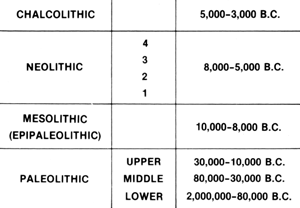
The evolutionary chronology begins at approximately 2,000,000 years B.C., a date with which the majority would agree, although some dissent could be registered. This begins the Paleolithic period, which can be subdivided into Lower, Middle and Upper Paleolithic:-
Lower Paleolithic 2,000,000 - 80,000 B.C.
Middle Paleolithic 80,000 - 30,000 B.C.
Upper Paleolithic 30,000 - 10,000 B.C.
Next comes the Mesolithic for which varying terms are used, namely, Epipaleolithic, Mesolithic and Protoneolithic. The broad category of the Mesolithic occupies the time between 10,000 and 8,000 B.C. Approximately 8,000 B.C. is the date given for the Neolithic period which extends up to approximately 5,000 B.C. In the Levant, the Neolithic has been divided into four periods, labelled 1 to 4. At 5,000 B.C., and extending onwards until 3,000 B.C. we come to the Chalcolithic or the copper stone age, with its sub-divisions varying according to the regions.
These details can all be seen in Figure 1.
The stone age chronology is clearly evolutionary, and occupying a period of approximately 2,000,000 years, telescopes down as we get closer to the present. It begins, by definition, where our supposed ancestors finally developed into Homo Erectus. Homo Erectus occupies a large portion of the Lower Paleolithic until the theoretical development of Homo Sapiens or modern man, from which time cultural evolution is prominent.
These supposed time cultures have to be defined and this is done by means of artifacts. The following indicates how:
- Paleolithic. Usually defined on the basis of stone implements alone.
- Mesolithic. Defined in terms of stone implements and some evidence of building, usually with either rock or clay materials.
- Neolithic. Defined in terms of
- stone tools,
- some bone tools,
- early pottery development,
- evidence of early farming communities, and
- evidence of buildings and town structures.
- Chalcolithic. Defined in terms of stone and metal tools, bone tools and other artifacts, pottery, town and village communities and farming communities, but particularly the introduction of metal (mostly copper) used in weapons and other implements.
Both these time cultures are defined as hunting-gathering cultures.
The essential ingredients in putting together such a chronology as the above are:
- the assumption of a developmental history of mankind anatomically and culturally; in other words, an evolutionary framework as a first base assumption; and
- the acceptance of various dating techniques for absolute values in dating human habitation.
Let us now look at the second of these two assumptions, the dating methods.
Dating Techniques
The scientific method can only work in the present, for it only has its artifacts in the present with which to experiment and to investigate. Reasonable scientific conclusions can be reached about those artifacts in the framework in which we find them, whether these be tools or cities or fossils. However, as we extrapolate the observations into the past we immediately step out of the scientific method and into the area of historical assumption. This is not science but mere reasoned conclusions, however acceptable they may be to one’ reason.
It follows naturally that if the scientific method cannot work in the past and conclusions about the past must rest on assumptions, then there is not today a dating method that can be scientifically substantiated as being correct, for every method will have built into it an assumption. Now when we come to the practical application of this theory we discover in fact that this holds true. Let us look at the methods available.
There are many methods now available for dating. We will mention the more obvious, all of which are used to obtain an absolute date (we are not here referring to the primary chronological arrangement or relative dating). The discussion will not be concerned with a lengthy treatise on the subject matter as this can be found in a number of other places.
Fossil dating.
This is largely irrelevant in this context as it is used for much greater periods of time. However, it is used to some extent in the Lower Paleolithic strata as here defined. Fossil dating assumes that the fossil can be dated by the rock in which it is found, and dating of the rock in which it is found assumes that it can be dated by the fossil which is found in it. This is, of course, circular reasoning and is frankly invalid.
Radiometric dating.
Radiometric methods assume that we can estimate the amount of radio active substance with which we began the time clock, a doubtful proposition, since that was a past event. It usually assumes a constant decay rate whereas of recent years some doubt has crept into this assumption, and in most cases it assumes no outside interference that has altered the system.
Carbon-14 dating.
Carbon-14 (or radiocarbon) dating in particular assumes that the influx and outflow of carbon-14 atoms into and out of the biosphere is in equilibrium. This simply is not so, and that alone invalidates the method. Massive variations have been found. Furthermore, all the assumptions that are made for the other radiometric methods essentially apply here, and these make all radiometric dating methods doubtful as scientific tests.
Dendrochronology, or tree-ring dating.
This method is assumed by many to be able to ‘correct’ the carbon-14 clock from its drift of measurements. However, it assumes a number of things. Firstly, it begins its estimation with a carbon-14 date!1 This introduces circular reasoning again. It assumes also that a tree grows a single ring every year. This is simply not always the case, for some trees have been found to put on multiple rings each year, while other trees have been known to put on no rings in a particular year or for several years, particularly in dry times. It also assumes that conditions over small areas are the same as far as climate and soil conditions are concerned, but most gardeners can tell you that the growth potential for any tree can vary across very small distances in any one place. This is rarely taken into account in dendrochronology. Dendrochronology, in fact, is so shot through with assumptions that it is surprising that anyone dared to present it as a scientific test.1
The written word including coins.
This assumes that the author is reliable or that the details are not inaccurately copied and can be verified.
A quick perusal of the above list will show very quickly that none of these methods qualify as a scientific test for dating the past, for all of them rest upon assumptions. Furthermore, these principles can be extended to other tests and all will be shown to be based on assumptions.
What then can we say of dating the past? Simply this - the past, as far as its historical narrative is concerned, must begin with some form of assumption and that assumption will be determined by the particular bias or world view held. A person’ bias totally includes his religious view, which shapes his thinking about the universe in which he lives and in which his ancestors lived, so that we see that history is built upon three things:-
- artifacts that have come down from the past,
- assumptions to extrapolate those facts into the past, and
- personal bias held by every historical interpreter.
These biases will be as varied as human kind.
Discussion of the supposed ape-like ancestors of man will not be dealt with here. They have been very adequately discussed by Bowden.2
The problem with the evolutionary chronology of the ancient world presented above is the following:
- There is a rival claim to the history of the ancient world found within the pages of Scripture, and
- That particular rival view of history forms the historical framework of a legal claim which affects the hope of the world, the faith of nations and the eternal well-being of the human race.
So the discussion of the ancient world is taken out of the realm of merely the purely academic into the realm of every man. It becomes relevant to every human being upon the face of the earth. Whether the biblical creation model of origins stands the test, as opposed to evolutionary theory, will determine the hopes and dreams of mankind down through the ages and right throughout the vast world today. It is for that reason that the true model of the ancient world must be determined to see which faith can claim our allegiance, and which faith, if any, determines our destiny. Let us then look at the second model, that is, the biblical model.
A better model - Bibilical chronology of the stone age
In order to arrive at a terminus for the so-called stone age against the biblical narrative a number of new details must be taken into consideration. Firstly, there should be the fact that the biblical chronology inserts a catastrophic world-wide flood of momentous proportions that was so devastating that it is unlikely that any artifacts of the world before that flood would be likely to be found on the surface of the earth today. They would be buried deep within the rock strata of the earth. Therefore, the assumption must be made that all the surface artifacts of civilization with which the archaeologist deals must relate to mankind’ history after the great Flood of Noah which has been dated by this writer to be circ. 2,300 B.C.3 This allows us a starting point at 2,300 B.C. The end of the stone age has been accordingly determined in the preceding article (‘The Times of Abraham’, this volume) at approximately 1,870 B.C. during the early days of Abraham’ life in Palestine. The reader is warmly referred to the discussion in that paper.
So we are left with the period from 2,300 B.C. through to 1,870 B.C. for the period of mankind’ history that the evolutionist would call the stone age. This is obviously significantly shorter than that proposed by those who hold the former evolutionary chronology. Such a reduction in time seemingly defies the imagination. However, the writer wishes to demonstrate in this paper that all that is known of these earlier ages of man can in fact be satisfactorily interpreted within that framework of time.
Following are the details of that biblical model.
Genesis 11 verses 10-32 present to us a single family genealogy of the ancient world from the time of the great Flood until the days of Abraham. Figure 2 gives these details in diagrammatic form, from the Flood until the early years of Abraham’ life in the land of Canaan.

It can be seen that the period from the Flood until the early years of Abraham, if we count the latter at 1,870 B.C., is approximately 432 years. However, Genesis 10:35 against the Genesis 11 genealogy suggests that the catastrophe of Babel may well have been in the fourth generation born after the Flood, which we may approximate to about 100 years. Therefore, we are allowing a post-Babel period until the end of the stone age of 332 years.
The chronology here of the Massoretic text alone is accepted as valid.4
Now the biblical model, Genesis 11:1-9, tells us that the population (apparently fairly homogeneous) had one language and they journeyed (apparently together) to ancient Sumer. We would need to date this just before 2,200 B.C., being specifically the date of the dispersion at Babel. Therefore, we may conclude that some of the artifactual evidence found in Sumer may well pre-date 2,200 B.C. by a few years.
However, all the rest of the civilizations of the ancient world will have to be seen as post-Flood and post-Babel, and therefore after 2,200 B.C. Consequently, on the biblical model, any other civilization outside of Mesopotamia, with the possible exception of small areas along the route between Ararat and Sumer, would have to be dated from 2,200 B.C. until 1,870 B.C. for a stone age period, that is, for all that is embraced within the Paleolithic to the end of the Chalcolithic, wherever such a relative chronology can be applied satisfactorily.
Present evolutionary theory sees man’ origin somewhere around the African continent and spreading in many different directions. As far as the concept of civilization is concerned, most would agree that the zenith of mankind’ early civilization was the early Chalcolithic cultures of Mesopotamia. From here civilization is generally seen to have spread into many different regions.
Wherever a culture is dated as Paleolithic it is generally assumed to pre-date that which is labelled Mesolithic, which is in turn assumed to pre-date that which is Neolithic, which is then usually presumed to pre-date that which is Chalcolithic. Thus the Mesolithic culture in the lowest level of Jericho would be assumed to pre-date the Chalcolithic culture of Eridu in Mesopotamia, despite the fact that the ancients regarded Eridu as the oldest city on earth.
This developmental type concept has rarely been seriously challenged. It is, however, here completely challenged.
In order to understand the significance of the biblical model in relation to the archaeological evidence of the ancient world, let us look at two phenomena as guiding principles:
- The pond ripple effect, and
- The mushroom effect.
The pond ripple effect.
When a stone is thrown into the middle of a pond concentric waves pass outwards in all directions from the catastrophic centre. This principle indicates that if there is a catastrophe it is reasonable to suppose that from the centre of that catastrophe, whether it be water or people, waves of effect will pass outwards in all directions available for that movement. In the biblical model, the centre and place of catastrophe is Sumer, southern Mesopotamia. When a population is in crisis and is thrust outwards into a new geographical location, their first business is to survive. They will survive by every means possible at their disposal, and cultural niceties would be put aside until the question of survival had been completed and sufficient time and leisure was available for them. So a population of people driven from the centre, namely Mesopotamia, as result of some catastrophe, which included in the biblical model the confusion of tongues and the hostilities engendered following this, will cause people to migrate in different directions in order to find a new place to live, free from dispute and trouble. They will use whatever is available, whether it is stone, wood, grass or mud. They will hunt. If they have more time they will plant crops and gather various types of food primarily in order to survive.
A society that is forced to hunt and gather because of insufficient time to plant crops will then be called a hunter/gatherer society. It will exhibit the tools of that trade. It is likely, therefore, in most cultures in new places, that the first stage would be a hunter/gathering society in order to gather whatever is available to survive and live. As they were able to come to terms with their environment, they would begin to farm and to herd animals. It would be assumed by the archaeologists later excavating such a site that there had been a development of culture. But this is not necessarily the case, for this particular society would have had all that culture available to them right from the start. The difficulties would simply have been those of making it a reality in their environment, until sufficient leisure allowed them to do so.
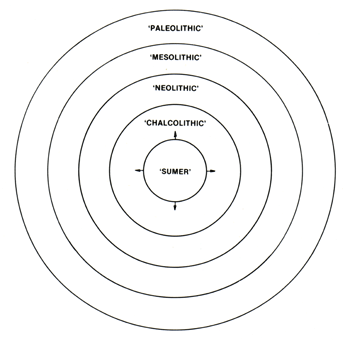
However, if a person or society had been driven only a short distance from Mesopotamia and had sufficient ability to take many of their cultural niceties with them, such as the implements and tools for metal making and metal culture, then they would possibly be able to enjoy culture from a much earlier time. This would result in the later excavation of a Chalcolithic type of culture. It would, of course, be assumed to be later than the Paleolithic hunter/gatherer society or the Neolithic farming society discovered in a more outlying region. However, this would not necessarily be the case. The Paleolithic, Neolithic and Chalcolithic could well be contemporary, and might simply be an indication of the different conditions and the different environment and distance from the centre point available to each of the different cultures. This may be illustrated as in Figure 3.
Further on it will be argued and demonstrated that there is evidence in Mesopotamia and the Middle East that such cultures as Chalcolithic and Neolithic existed side by side, and, therefore, there needs to be a radical re-evaluation of the presently held serial arrangement of the Middle Eastern cultures.
The mushroom effect.
Presently held in Mesopotamian chronology is the idea that the majority of the five great Chalcolithic cultures of Mesopotamia were not contemporary with one another but knew a serial arrangement.
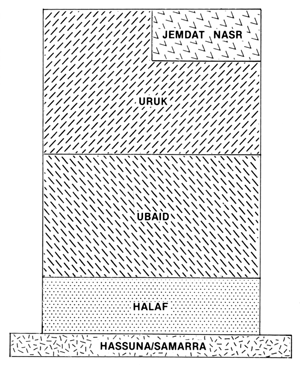
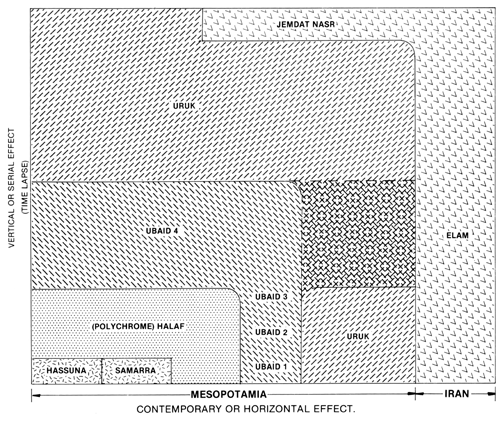
This concept again appeals to proponents of evolutionary theory, but is not necessarily supported by hard evidence. The mushroom effect here proposed allows both a horizontal and a vertical or serial evaluation of a culture to be made. As a civilization grows, it will gradually overflow into other areas by either trade, migration or conquest, or a combination of these.
Details will be presented to suggest that most of the Chalcolithic cultures of Mesopotamia were in fact contemporary in their earliest periods, but mushroomed under different conditions at different times, thus allowing a possible serial arrangement in vertical perspective for each of these cultures in turn (see Figures 4 and 5).
Historians in the past have emphasized the serial or vertical mushrooming aspect of this without giving due recognition to the horizontal or contemporaneous aspect of such civilizations. This, of course, was implicit in their evolutionary theory and would tend to bias their understanding and allow them to overlook it.
Application to data.
1. Halaf-Neolithic 4.
In 1982, under the title ‘A Four-Stage Sequence for the Levantine Neolithic’, Andrew M.T. Moore presented evidence to show that the fourth stage of the Syrian Neolithic was in fact usurped by the Halaf Chalcolithic culture of Northern Mesopotamia, and that this particular Chalcolithic culture was contemporary with the Neolithic IV of Palestine and Lebanon.5:25
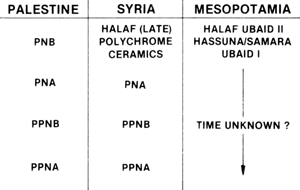
This was very significant, especially as the phase of Halaf culture so embodied was a late phase of the Halaf Chalcolithic culture of Mesopotamia, implying some degree of contemporaneity of the earlier part of Chalcolithic Mesopotamia with the early part of the Neolithic of Palestine, Lebanon and Syria, as illustrated in Figure 6.
This finding was not a theory but a fact, slowly and very cautiously realized, but devastating in its effect upon the presently held developmental history of the ancient world. This being the case, and bearing in mind the impossibility of absolute dating by any scientific means despite the claims to the contrary, the door is opened very wide for the possible acceptance of the complete contemporaneity of the whole of the Chalcolithic of Mesopotamia with the whole of the Neolithic and Chalcolithic of Palestine. (The last period of the Chalcolithic of Palestine is seen to be contemporary with the last Chalcolithic period of Mesopotamia.)

Cultures of Mesopotamia seem to come into life fully developed, at least in so far as southern Mesopotamia is concerned. Evidence for the Neolithic is very scanty in that part of the country between the Tigris and Euphrates Rivers, yet the further we go out from this centre, whether it be into Palestine or up into the Zagros Mountains, we come to apparently increasing ‘primitiveness’ of cultural type, a condition that at once may be seen to be pictured in the pond ripple effect previously discussed. What we need to determine, however, is the following:
- whether hard evidence above and beyond the previously developed data can be brought to bear to show the contemporaneity of other periods not yet discussed,
- whether the strata levels in which some of these supposed primitive cultures are found are consistent with short periods of time,
- whether a mechanism is available for rapid build-up at times of rather deep strata layers, and
- whether we stand on solid scientific ground to back such interpretation of short periods rather than the long periods of time presently proposed.
This problem is most acute when we come to the caves of Palestine and the Zagros Mountains, which show great evidence of deep burying of artifactual material within those cave sites. Here is a situation that has given the evolutionists some courage to assume long periods of time. This, however, need not be the case.
Let us then look for this evidence, examine it, and then attempt to re-write the history of the stone age period in terms of the known biblical chronology.
This author is not the only one who has suggested the possibility of contemporary cultures for some of the periods previously thought to be serial in Mesopotamia. Joan Oates raised this very possibility with regard to some of the early Chalcolithic cultures of Mesopotamia:
‘Although our present evidence is insufficient, it seems to suggest that Hassuna preceded Samarra (whether or not the latter is considered a separate assemblage) throughout Assyria and in the Samarra area, but we must not lose sight of the possibility that Hassuna, Samarra, and Halaf may all prove to be local and perhaps even contemporary adaptations.’6(emphasis ours)
2. Halaf Polychrome Ubaid II, Samarra.
There is yet more evidence to suggest many of these cultures were contemporary, particularly with regard to the Chalcolithic of Mesopotamia. For instance, Jasim7 presents evidence from the excavations at Tel Abada to show that this was in fact the case with regard to Ubaid II, Samarra and Halaf. The Halaf here, of course, is the Polychrome culture of late Halaf and is the same culture that is known to have penetrated Syria to replace the Neolithic IV there.5
So we can see a contemporaneity of Samarra, Ubaid II, Halaf (late) and Neolithic IV of Palestine. This is hard evidence from excavations that cannot be lightly dismissed and almost certainly speaks of contemporary cultures (Figure 7).
The biblical model of contemporary cultures differing in their material culture, and thus allowing Neolithic and Chalcolithic type cultures to co-exist, is also a significant model to explain the great difficulties surrounding the city of Jericho.
3. Jericho Neolithic — Ghassul Chalcolithic.
Robert North8 discusses an apparent 300-year gap at Jericho between the Proto-Urban and Early Bronze cultures. The Proto-Urban is described by different investigators in different terms, by some as Late Neolithic, by others as Chalcolithic of various stages. Certain features of Jericho culture during the Proto Urban or Level VIII (Garstang) reflects Chalcolithic, related to the Chalcolithic at Ghassul. However, the features are few enough to allow the majority of excavators to feel that the Jericho Proto Urban culture is still Neolithic in type, and so a gap of some 300 years, resulting from the old evolutionary scale used, has to be inserted between the end of Proto-Urban and Early Bronze I in Jericho, not so much on solid evidence of such a gap, but simply because of the rigid evolutionary terminology. The biblical model, however, not only shortens the time of the necessary gap, if such ever occurred, but also allows a still conservative Neolithic type of culture in Jericho to subsist beside a progressive Chalcolithic culture across the Jordan at Ghassul.
The possibility of contemporaneity was slightly broached by Robert North when he says:
‘From the very start, however, certain remote or rare similarities to Ghassul in the Pre-bronze Sultan materials have been noticed, always leaving open the chance that Ghassul could be a contemporaneous local variation due to immigrants.’8:66
He finishes with the statement:
‘In any case Ghassul-Jericho comparison confronts us with an enigma still unsolved despite persistent efforts: in face of which there is need of bold innovating scientific hypotheses.’8:66
The biblical model is, in fact, the only reasonable ‘bold innovating scientific hypothesis’ that will satisfy the demands of this region. I conclude that it is reasonable to suppose that there was no considerable gap between Proto-Urban at Jericho and Early Bronze I, but rather that a conservative Jericho culture did in fact subsist beside a progressing Chalcolithic Ghassul culture across the Jordan River, with a different people in a different place, but at the same time.
The problem with such data as this is that the rigid evolutionary terminology does not facilitate easy bending to allow its adherents freedom to see such cultures as Neolithic and Chalcolithic as contemporary.
We find then, sufficient evidence to hold in question the rigid evolutionary sequential framework of Neolithic to Chalcolithic that has been held for so long. Evidence has been presented to show that there is contemporaneity of previously claimed sequential Chalcolithic periods, and also contemporaneity between Chalcolithic periods on one hand and Neolithic on the other, certainly in Syria, and possibly also in Jericho and the Jordan Valley. If such is the case, then we have reason to call into question the long time periods and the sequential arrangement of other cultures from Paleolithic right through to the end of the Chalcolithic in the whole of the Middle East. It is much more reasonable to propose a model embracing the ‘pond ripple’ and ‘mushroom effect’ (referred to above) against the background of the biblical chronology, which even to this day remains the only written record of claimed history of this period.
Deep strata - how long?
The question, however, may be asked: What about the deep layers and numerous strata concerning the so-called Paleolithic of Palestine found in such places as the Carmel Caves? In order to answer such a question we have to look at two other major questions first:
- the climate, and
- the rate of sediment build-up.
It will be proposed here
- that the climate in the early post-Flood earth around the Middle East was in fact much wetter and far more forested than it is today, making a considerable difference to the sediment build-up, the disintegration of stone material, perhaps even the tool types used by the inhabitants, and certainly their manner of life; and
- that sediment build-up was in fact much faster than is claimed today, particularly bearing in mind the weather conditions.
A wet middle east and heavy strata build-up
The biblical model implies that there would have been much more water left over in land basins as a result of the great Flood than would necessarily be present today, and so we would look for evidence of large lake-like accumulations in such possible basin areas. The biblical model certainly does not insist on any particular weather conditions immediately after the Flood, but wet conditions would certainly be logical in God’s planning for the habitation of the post-Flood earth, and would be logical in terms of the necessary rapid build-up of plant and animal life again after the Flood. As a result of the Flood, there would have been much salt left on the land, so wet conditions would have caused a washing off of some of this salt from the land and a faster ability of non-salt-loving plants to grow adequately, allowing for quick afforestation, an abundance of plant life, and hence a multiplication of animal life after the great Flood. Wet conditions would have increased the breakdown of mud-brick buildings, increasing therefore the build-up of strata in tells during the early days in the Middle East and causing more rapid build-up in caves, particularly in dolomite and limestone caves.
There is strong evidence for a very wet climate in the Middle East and for left-over basins of water over many areas of the Middle East in the early days which the biblical model would allow to be called post-Flood, but which the evolutionary model would call the stone age.
Palestine in those early days showed evidence of great areas of water, particularly filling in the north of the Huleh Basin:
‘It is currently accepted that during the period of Acheulean occupation of the north-eastern tip of Upper Galilee, a large lake filled the entire Huleh Basin while the mountains were covered by oak forests incorporating several northern elements. such as Fagus. The surroundings were rich in various animals, including a number of large species. The Acheulean site was apparently located close to the ancient lake, in the vicinity of streams descending from the Hermon (Stekelis and Gilead, 1966; Nir and Bar-Yosef, 1976; Horowitz 1975-1977).’9
Also in south-central Sinai:
‘Strikingly thick accumulations of sediments occur in Wadi Feiran and its tributaries in south central Sinai (Fig. 1). Over the past three decades these have been the subject of discussion with reference to their origin (fluvial verses lacustrine) and their climatological and chronological significance. In this note we describe an in situ Upper Paleolithic site, the first known from south central Sinai, which places these deposits in a firmer chronological context of about 30,000 to 35,000 B.P. and lends support to previous climatological interpretations of a former wetter climate.’’10:185
And:
‘Nevertheless, the widespread occurrence of Upper Paleolithic sites throughout the central Negev and down to the very arid southern Sinai would suggest a regionally wet climate, which enabled the Upper Paleolithic people to exploit an area which today is hyper-arid.’10:189
Furthermore, in east Jordan:
‘Briefly, the stratification in the north, west, and south trenches reflects the existence of a Pleistocene pluvial lake that shrank until a widespread marsh formed during the Early Neolithic.’11:28
And again:
‘During the Late Acheulian period of the Late Pleistocene, the scene around Ain el-Assad was quite different: an immense lake, roughly five times the size of the present Dead Sea (Rollefson 1982; Garrard and Price 1977) stretched to the northern, eastern, and southern horizons. Once again, animals would have been attracted to the lakeshore, yielding opportunities for Neanderthal hunters to fulfill their needs.’11:33,34
Similarly, Alison Betts has suggested that in the Black Desert just close to the same area in eastern Jordan there was once lush growth and a large population of animals:
‘As far as hunting is concerned, the desert once supported large herds of game, particularly gazelle, and evidence for the wholesale exploitation of these herds is demonstrated by the complex chains of desert ‘kites’ lying across what were once probably migration routes.’12
In Egypt also, wet conditions prevailed:
‘Naqada I and II are very remote times, and it is now known that conditions in Egypt were then completely different from what they are today. At Armant, for instance, south of Luxor, large trees had been growing sparsely all over the low desert at a height of 20 or more feet above the present cultivation level and, therefore, probably about 40 feet above in pre-Dynastic times. The workmen told Mr. Myers that trees like this were to be found in every part of the Nile Valley. Some of these trees at any rate were earlier than either the Late or the Middle pre-Dynastic periods, for graves of these dates had been cut through their roots. Again, a small Wadi had been silted up and trees had been growing in it. This was all on the low desert, and similar wet conditions are found to have prevailed on the high.’13
The testimony seems uniform that in those early days, by whatever scheme they may be dated, conditions were wetter and large areas of water-filled geographical basins, a picture that is thoroughly consistent with the biblical model.
Wet conditions and afforestation may well be one of the explanations for the earliest type of culture found in many parts of the Middle East and Europe, that is the Acheulian, the most characteristic tool of which was the hand-axe. The need to clear land, to chop trees, and to build shelter from wet conditions, as well as to shape tools such as spears for hunting in that early survival culture, may well explain the ubiquity of the Acheulian hand-axe, a fairly basic tool. But then, the conditions also were very basic, and survival was the name of the game.
The wet conditions may also explain the very large number of stone-age, particularly Neolithic strata, in such places as Mersin, Catal Huyuk and Jericho, where the main building materials were sun-dried mud bricks. In north-eastern Iraq the Jarmo expedition found that the average expectation for a ‘casually built house with some dried mud bricks and mud finished roof’ was only 15 years.14 In much wetter conditions of earlier days the life of a building may well have been considerably shorter, even half that time, making rapid build up of strata with rebuilding of levels in tells a very highly likely proposition.
Furthermore, the deep layers found in some of the caves, such as the Carmel Caves, which are dolomite, may well be explained by the wetter conditions which would give rise to the more rapid breakdown of rock from the roof. Such cave-ins, which were evident in some of the Carmel Caves, along with the increased trampling in of soil, dirt and mud as the people came home from hunting, would have led to a rapid build-up of strata in such caves. It is impossible at this point in time to give an accurate assessment of the time taken for the build-up of these strata. Long periods of time that have artificially been assigned to them simply cannot be sustained on any present evidence. For these reasons, the biblical model stands as a reasonably good scientific model on which to test the evidence.
New regional models for the stone age
Palestine
The following cultures are recognised for the stone age of Palestine,
- The Lower Paleolithic - Acheulean.
- The Middle Paleolithic - Mousterian.
- The Upper Paleolithic - Aurignacian.
- The Epi Paleolithic, sometimes called Mesolithic.
- Kebaran culture
- Natufian culture
- The Neolithic.
- Neolithic (1) or Pre Pottery Neolithic - A (PPNA)
- Neolithic (2) or Pre Pottery Neolithic - B (PPNB)
- Neolithic (3) or Pottery Neolithic - A (PNA)
- Neolithic (4) or Pottery Neolithic - B (PNB)
- The Chalcolithic.
- Wadi Rabah culture
- Esdraelon culture
- Ghassulian culture
Here rejected are the long time periods assigned to these cultures, but let us look further at them:
Acheulean
The characteristic feature of this culture was, of course, the large hand axe prominent in it. Comment has already been made about the possible relationship between the virgin forests, an early spreading people, and the necessity to use hand-axes in much of their culture. The widespread common relationship of these tools in Europe, Asia and Northern Africa certainly is not inconsistent with the biblical model of the recent origin of the spread of people from the Middle East into diverse places having initially similar cultures.
There does seem to be a definite stratigraphic relationship between the so-called Paleolithic strata - Acheulian, Mousterian and Aurignacian in ascending order. This, however, does not indicate that they were cultures that succeeded one another all over the country, but the principle of mushrooming may legitimately be investigated here as in the Mesopotamian Chalcolithic. In other words, the superposition of one stratum on the other may only be a measurement of the cultures in one dimension. It fails to come to terms with the possible horizontal contemporaneity of at least the last two of these cultures, the Mousterian and the Aurignacian.
The Aurignacian seems to have at least a superficial relationship to the later Kabaran culture. In the caves of Mount Carmel, the Kebaran and the Aurignacian seem to be geographically related.15 This possible relationship is worthy of further investigation. Thus when we get to the Epipaleolithic or Mesolithic we find a horizontal relationship at least a possibility. Different geographical areas are indicated on the whole for these two cultures:
‘The Kebarans were based predominantly in the coastal plain making seasonal penetrations into the mountainous areas to supplement their subsistence.’16
And further:
‘When Natufian sites are plotted on a soil map of Palestine they are seen to coincide with the distribution of the Terra Rossa and the isohytes of 800 to 400 mm (Fig.1.) These settlements were base camps where remnants of structures, heavy grinding tools, burials and numerous sickle blades are found.’16
Kebaran - Natufian.
Kebaran culture seems to have been a less vigorous culture than Natufian and may have been overwhelmed by the latter.
Neolithic.
Neolithic (1) or Pre Pottery Neolithic A of Palestine appears to have been very much the same as the Mesolithic Natufian culture. This is apparent at Jericho from Kenyon’ excavations.
Chalcolithic
A case has already been made for the Ghassul culture to have been Amorite (see ‘The Times of Abraham’, this volume). Furthermore, it may well have been in Canaan during the Late Neolithic, as suggested by North (Jordan I),8
One thing is clear from the biblical model; all the Stone Age inhabitants of Palestine, unless they happened to be transient cultures passing through to other lands, should be grouped under the label ‘Canaanite’ according to the biblical tradition of Genesis 10.
A further suggested identification is here made, that is, to equate the most dominant archaeological culture in Palestine of this era, namely, Natufian - PPNA-PPNB (suggestion of continuity after Moore5:16-23), with the Bible’ most widespread southern groups - the Hivites (see Genesis 36:2,20; 14:6 Horites = Hivites; also later in Palestine, Genesis 34:2).
PNA appears to be from the north and may indicate a Hittite influence (Genesis 15:20 and 25:9), or the same may be speculated of Proto-Urban Jericho (equivalent to Chalcolithic - see North8) who had rock cut tombs.17:273
It is, however, freely admitted that the last two attempted reconciliations are tenuous and speculative for the most part, but worth investigating.
PNA appears to have arrived from the north; as did Proto-Urban Jericho.
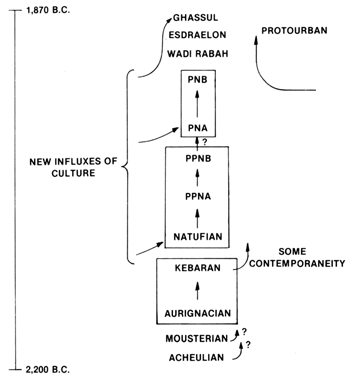
We have then several major influxes or migratory waves:-
- Acheulean
- Natufian
- PNA
- Proto-Urban
- Ghassul
All are considered to be Canaanite (see Figure 8). For this period the Bible allows from Babel to Abraham (in Canaan), that is, from 2,200 B.C. to 1870 B.C. or 330 years (see ‘The Times of Abraham’, this volume).
An overlap of several of these phases is strongly suggested. As Kenyon has stated:
‘In trying to fit into place the cultures these communities represent, we should learn a lesson from the progress of research in European prehistory. Earlier European scholars tried to place each culture observed into a regular sequence. Now it is recognised that many cultures represent regional developments, and several may have existed side by side. The older sequence-method tended to produce very inflated chronologies, which have had to be considerably reduced now that the picture has become more coherent. This we should bear in mind in trying to piece together the jigsaw puzzle which our present state of knowledge in Palestine represents, and in fact some of the new pieces of the jigsaw which almost every year emerge from the ground do suggest that the whole picture will eventually portray a number of groups of people living side by side each with their own distinctive culture, but with just enough links with other groups to suggest contemporaneity.’17:69,70
In time even the above conservative table (Figure 8) may have to be considerably telescoped down.
The Model: A Preliminary Hypothesis
From the dispersion of Babel into the virgin forested lands of Palestine came the families of Canaan - Genesis 10:15-19. The initial number of families is unknown, but they are represented culturally by the Palestinian Acheulean artifacts.
Their culture was consciously adapted to their new environment of heavily forested country and wet climate with large lakes in land basins, much of the water being left-over from the great Flood. The wet climate would have produced heavy sedimentation of the open land and friable conditions in many caves, which nonetheless were good protection from the climate.
From the Acheulian background two different developments came - the Mousterian and Aurignacian of Palestine. At Carmel the Mousterian shelters suffered collapse, possibly from earthquake,15:176 ending Mousterian habitation in them. Geographically at least, the Aurignacian appears to have given rise to Kebaran culture.
The Natufian appears to have been invasive, probably from the north, but possibly having a memory of a riverine background:
‘All that may be said at present is that the Natufian settlers came from an Alluvial environment and brought with them a tradition of building in clay or pise.’18
Moore affirms that Natufian to PPNA then PPNB formed one cultural continuity.
A new invasion from the north came with the PNA culture, continuous with PNB. But against the biblical model, this also must have been a Canaanite culture,5:23 as was all before it.
Proto-Urban possibly followed, contemporary with Ghassulian culture (North8) and possibly had a relationship with the Esdraelon culture of the North Palestine area. But with it came rock-hewn tomb burials, suggesting a possible connection with the Hittites of Genesis 23:9.
We seem to be on surer ground when identifying Ghassul with the Amorites (see ‘The Times of Abraham’, this volume), a wave of Canaanites which came down through southern Syria. They were perhaps related to the defunct Hassuna culture driven out by Halafian expansion, which enveloped Hassuna and Syria, and more particularly, Aram-Naharaim.
Egypt
‘Prehistoric’ cultures of Egypt are:-
- Paleolithic
- Neolithic
- Chalcolithic
- Naqada I (Amratian)
- Naqada II (Gerzean)
A case has already been made for a wet early Egypt, with wetter conditions thus over the whole of Africa, bringing greater flood and silt deposits into the Nile Valley, which buried Paleolithic artifacts in deep silt - all an illusion of a long time period.
The Bible makes it clear that Egyptian culture arose from the family of Mizraim and his sons (Genesis 10:13-14):-
Ludim
Anamim
Lehabim
Naphtuhim
Pathrusim
Casluhim - from whom came the Philistines
Caphtorim - from whom came the Philistines also.
Egypt thus was from its very beginnings a tribal nation, suggesting multiple dynasts right from the start. The Pathrusim are remembered in southern Pathros, while the Caphtorim appear to have settled in the northern coastland areas (see ‘The Times of Abraham’, this volume). The name Lehabim is said by some to be the origin of the name of Libya. If that be so, his descendants will have settled in the west.
The Egyptian language itself is considered to have had a common ancestor with the Semitic languages, and not to have been derived from it.19:193
This is, of course, close to the biblical model.
Egypt was a corridor for the movement of people into Africa after the crisis of Babel. This multitude of cultures should be reflected in the earliest times, is dated by the biblical model to approximately fifty years after Babel at approximately 2150 B.C., and later. On the evolutionary chronology this period would most likely be called Paleolithic.

Clarke says:
‘Between the close of the Pleistocene and the introduction of domestication, somewhere between about five thousand and three thousand two hundred B.C., an extremely interesting situation existed in the Nile Valley. We find here a mosaic of cultural traditions which preserved their individuality in the face of the opportunity for interaction and free exchange of ideas’19:169 (emphasis ours)
Egypt was early recognised as two nations - lower (north) and upper (south) Egypt. Upper Egypt was known as Paphros, perhaps a derivative from Mizraim’ son Pathrusim. The dominant northern name appears to have been Caphtorim.
Remains of farming/pottery-making communities belonging to those early days have been found in Egypt. These were the Neolithic communities. Three important ones are here mentioned. In the north 30 miles north-west of Cairo was Merimda - Beni Salama (see Figure 9), a village community dwelling in reed huts. They stored grain in straw and clay silos and appear to have had goats, sheep, pigs and cattle. This appears to be culturally distinct from Neolithic Fayuma at Birket Karun further south (Figure 9). These people were subsistence farmers who grew emmer wheat and flax on the shores of the lake. Yet further south was the Tasian/Badarian culture on the eastern bank of the Nile, exhibiting some of the finest pottery work ever produced in the Nile Valley.
Contemporaneity of these three cultures is a reasonable proposition and on the biblical chronology would perhaps be dated at around 2100 B.C.-1950 B.C.
Clarke indicated a direct transition from Neolithic to Chalcolithic : Following this Neolithic ‘period’ we talk of the pre-Dynastic period or Chalcolithic, which is divided into two stages/cultures:-
- Naqada I or Amratian (from El Amra in the South - see Figure 9)
- Naqada II or Gerzean (from Gerza in the North - see Figure 9)
These and the preceding Badarian have been found in a stratified context indicating a local sequence.20:391 This does not, however, rule out spatial contemporaneity (see the earlier discussion of the mushroom effect).
The supersedure of Gerzean culture seems to indicate a pre-Dynastic Northern dominance.21 It would be against this that the South fought in the wars that finally led to unification and the Dynastic history of Egypt, firstly under Scorpion then under Narmer, and then under Menes/Hor-aha. Narmer was apparently late Gerzean - Chalcolithic, and was contemporary with Arad I,22 or the end of Ghassul IV in Palestine, the end of which has before been dated at around 1870 B.C. during the days of Abraham.

Diagrammatically the model we outlined for Egypt can be summarised as in Figure 10. Note also that it was from the northern Chalcolithic of Egypt that the Philistine phenomenon came (see ‘The Times of Abraham’, this volume).
Mesopotamia
The earliest cultures of the alluvial plains of Mesopotamia are Chalcolithic in nature, with an early suggestion of Neolithic at Hassuna. These earliest cultures were:-
- Hassuna in the north contemporary with Samarra along the middle Tigris,
- Halaf in the north,
- Ubaid in the south,
- Uruk in the south, and
- Uruk - Jemdat Nasr in south.
affecting the north.
The Hassuna culture had affinities with Palestine and Cilicia (early Canaanite areas) in its archaic pottery. Georges Roux says:
‘This archaic painted pottery apparently originated in Syria-Palestine and spread eastwards. Samples of it have been found as far away from Hassuna as Jericho and Megiddo in Palestine. Here is therefore positive evidence of a community of culture in the whole area of the ‘Fertile Crescent’ from the Dead Sea to the Tigris, with a main focus along the Mediterranean. Moreover, the skulls from Hassuna which have been studied belong, like the skulls of Byblos and of Jericho, to ‘a large toothed variety of the long-headed Mediterranean race’ and suggest an underlying unity of population. Yet the so-called Hassuna standard ware predominant in levels IV to VI is peculiar to northern Iraq and seems to be an essentially local product.’23:62 (emphasis ours)
Seton Lloyd and Tuad Sofar say of Mersin in Cilicia:
‘Perhaps the most interesting evidence in this respect is to be found in the lower levels at Mersin. Here there is no very noticeable division between the pre-Halaf painted pottery and what follows. Directly beneath the fortified village at Level XVI (13.50 m.), in which Halaf pottery was found, there are 4 metres of settlements characterized by crude-brick walls and rather primitive painted pottery in many ways most surprisingly similar to our Hassuna archaic painted ware.’24:264
‘The similarity of the Hassuna archaic painted ware to the ‘proto-chalcolithic’ pottery from Mersin (levels between 13.50 and 9.50 m.) has been mentioned elsewhere (p.264).’24:279
‘The ware itself seems broadly similar to the earliest found at Jericho. It is buff in colour with blackened core and a generous tempering of straw, which when left on the surface, has disappeared. leaving impressions in the clay. The surface outside is wet-smoothed, occasionally shows signs of a very slight burnish, and is sometimes mottled with tiny cracks (Pl.XJII.1]. The tall-sided vessels usually have a group of two or more ‘nipple lugs’ on either side just beneath the rim (Fig. 6:1,7,15,17). There are examples also of semicircular or horizontal ‘knob-ledges’ (Fig.6:16) as in Jericho IX and one T-shaped ridge (Fig 6:16). Finally, there are examples of a dent in the rim for pouring. Fig 6: 18: and of a hole just beneath the rim, perhaps for the same purpose.’24:277
Suggestion has already been made to the possible ancestral link of Hassuna with the Ghassulian/Amorite, a Halaf infIuence also being present. The culture was swamped at Hassuna by the mushrooming Halaf culture (late-polychrome) - see Figure 5 again. This burgeoning late-polychrome Halaf superseded the Hassuna culture with which it was almost certainly contemporary in its earlier stages.
The Halaf culture dominated the Aram Naharaim area of Upper Mesopotamia, so it is therefore here suggested that it be equated with the early Aramites of Genesis 10:23. Their Halaf culture influenced areas of Palestine, west to Mersin, and eastward across the Tigris River, mingling with the Samarran culture at Abada.
So Halaf is almost certainly the early Aramite people, their pottery appearing to have a relationship to Samarra (? biblical Asshur) and Ubaid (biblical Chaldees). As Roux says in discussing the ‘Eridu ware’:
‘They contained a painted pottery which, in the opinion of experts, closely resembled the Hajj Muhammed pottery, but was also loosely related to the Halaf and Sumarra wares. Clearly then, the site had been occupied long before the Ubaid period began by a people somehow connected with the ‘Halafians’ in the north’23:68
The Halaf culture was finally overwhelmed by an Ubaid ‘invasion’, known as northern Ubaid (see Figure 5 again).
Ubaid was the first culture of Ur of the Chaldees and therefore may be linked to the biblical Chaldeans of Genesis, the sons of Arphaxad from whom also the Hebrews (and Abraham) came. Ubaid culture was strongest in the Eridu - Ur area, but affected north-eastern Saudi Arabia.25 Ubaid 4 finally swept northward, dominating Sumer and northern Mesopotamia, and almost certainly founding new cities such as Haran (a name which appears to be southern).
Historically such a cultural effusion makes it easy to understand the migration and settlement in Haran of Terah and Abraham who followed only a short period later, possibly during the following Uruk period or late northern Ubaid.
The Ubaid dominance was superseded by the Uruk period, a Sumerian dominance which was to hold sway throughout the next four periods - the Uruk, Uruk/Jemdat Nasr, Early Dynastic 1, 2, and 3, and Akkad - until the Amorite ascendancy. Uruk (biblical Erech - Genesis- 10:8-10) was connected with the Cushite Nimrod and his descendants, as here the ‘black headed ones’ almost certainly related to the other descendants of Cush in Africa. From Uruk came the Sumerian language and the cuneiform script, later to be mobilized for later languages such as Akkadian, Elamite, and Old Babylonian.
Finally, empire burst upon the ancient world with the Uruk - Jemdat Nasr hegemony, whose influence was felt as far as Egypt and Cilicia (Mersin). Its identification with the empire of Amraphel - Chedarlaomer of Genesis 14 has been discussed in ‘The Times of Abraham’ (this volume). It was an empire over whose demise lingers the name of Abraham (approximately 1870 B.C.).
Jemdat Nasr appears to have been a Sumerian outpost of the Elamite peoples and nation, descendants of Shem - Genesis 10:22. Ghirshman comments of that time:
‘Uruk IV: a period of capital importance in the development of Mesopotamian civilization, since towards its end came the invention of writing. Shortly afterwards, during the last centuries before 3000 B.C., a civilization arose at Susa which, though remaining under strong Mesopotamian influence, created its own writing, known as ‘proto-Elamite’ (Fig. 16), and was contemporary with the Jamdat Nasr period of the neighbouring plain.’26
Conclusion.
The model here presented covers the period of Babel until the incident in Abraham’ life with the Mesopotamian kings of Genesis 14. In secular history it covers the whole stone age to the end of the Chalcolithic of Palestine (Ghassul IV), and equates the biblical and secular records in time, viz. approximately 330 years.
The model begins with a catastrophe in Mesopotamia, that of Babel of Genesis 11, and postulates two effects:-
- A pond ripple spreading effect of cultures contemporary in time but different in type.
- A mushroom effect to explain the supersedure of otherwise contemporary cultures which, when viewed in only one dimension, appear to be merely sequential cultures.
This model is then used as a base against which archaeological evidence is mustered to show its veracity and right to be considered the true model of ‘stone age’ history.
It is admittedly a preliminary overview which needs much detailed regional elaboration. It is because of the preliminary nature of this model for the ‘stone age’ that only a brief archaeological overview of Egypt, Palestine and Mesopotamia during those early years is allowed for here.
References
- Sorensen, HG., 1973. The ages of Bristlecone pine. Pensee, 3(2):15-18.Return to text.
- Bowden, M., 1977. Apemen - Fact or Fallacy?, Sovereign Publications, Kent.Return to text.
- Osgood, A.J.M., 1981. The Date of Noah’ Flood. Ex Nihilo, 4 (1):10-13.Return to text.
- Anstey, M., 1973. Chronology of the Old Testament, Kregel Publications, Grand Rapids, pp.38-45.Return to text.
- Moore, A.M.T., 1982. A four-stage sequence for the Levantine Neolithic. Bulletin of the American Schools of Oriental Research, 246:13-34.Return to text.
- Oates, J., 1968. Iraq, 30:12-13.Return to text.
- Jasim, S.A., 1983. Iraq, 45:165-186.Return to text.
- North, R., 1982. The Ghassulin Lacuna at Jericho. Studies in the Archaeology of Jordan I, Department of Antiquities of Jordan, Hashemite Kingdom of Jordon, pp.59-66.Return to text.
- Ronen, G. et al., 1980. Israel Exploration Journal, 30:32.Return to text.
- Beifer-Cohen, A., and Goldberg, G.P., 1982. Israel Exploration Journal, 32:185-189.Return to text.
- Rollefson, G.O., 1983. Bulletin of the American Schools of Oriental Research, 252:28-34.Return to text.
- Belts, A., 1982. Levant, XIV:30.Return to text.
- Wainwright, G.A., 1963. Journal of Egyptian Archaeology, 49:18.Return to text.
- Stronach, U., 1961. Iraq, 23:99.Return to text.
- Olami, Ya-Aqov, 1984. Prehistoric Carmel, Israel Exploration Society, Jerusalem and M. Stekalis Museum of Prehistory, Haifa pp. 176-177.Return to text.
- Bar-Yosef, O., and Tahernov, E., 1970. Israel Exploration Journal, 20:148.Return to text.
- Kenyon, K.. 1960. Archaeology in the Holy Land, Ernest Bean, London, pp.69-70, 273.Return to text.
- Kirkbridge, U., 1967. Palestine Exploration Quarterly, 1967:12.Return to text.
- Clark, 0., 1970. The Prehistory of Africa, Praeger, New York and Washington. pp.169 and 193.Return to text.
- Gardiner, A., 1961. Egypt of the Pharaohs, Oxford, pp.185, 391, 591.Return to text.
- Emery, W.B., 1961. Archaic Egypt, Penguin, p.42.Return to text.
- Amiran, I 1978. Early Arad, Israel Exploration Society, Jerusalem.Return to text.
- Roux, G., 1964. Ancient Iraq, Pelican, pp.62, 68.Return to text.
- Lloyd. S., and Tuad Sofar, 1945. Journal of Near Eastern Studies, 4:264, 276, 279.Return to text.
- Bibby, C., 1970. Looking for Dilmun, Collins, pp.376-81.Return to text.
- Ghirshman, R., 1854. Iran, Penguin, p.45.Return to text.
Readers’ comments
Comments are automatically closed 14 days after publication.