Using the centro-symmetric cosmology of Moshe Carmeli, it is shown that there is
no need to assume the existence of dark matter to explain dynamics of galaxies in
the cosmos. Further, it is shown that in this cosmology the cosmological constant
or dark energy is a property of space-time. This can be interpreted in
a creationist cosmology as the power of the Lord giving a boost to the expansion
of the fabric of space as He stretched it out. He is the unseen force in the universe.
By the correct choice of field equations, the motions of the galaxies are described
without the need to resort to exotic particles. This description fits a finite galactocentric
universe, and is consistent with a creationist cosmology.
Dark matter is the term for the hypothesized matter in the universe required
to explain the missing mass problem of the standard cosmological / big bang model.
Dark matter supposedly interacts with normal matter by gravity, but does not absorb
or emit radiation, and thus cannot be seen. Big bang cosmologists propose that about
25% of the universe is made up of dark matter (possibly consisting of non-standard
particles, such as neutrinos, axions or weakly interacting massive particles [WIMPs]).1 70% of the universe in their models
is made up of the even more obscure dark energy, leaving 5% of the universe as ordinary
matter.
In the nineteenth century, dark matter was once blamed for the anomalous advance
of Mercury’s perihelion.2 Mercury’s
elliptical orbit around the sun advances, or precesses, by a very small amount each
orbit. The expected precession, according to Newtonian and Keplarian laws of planetary
motion, was inexplicably exceeded by 43 seconds of arc per century.
If our solar system was comprised only of the sun and one planet, that planet would
retrace its elliptical path perfectly forever, assuming Newton’ Law of Gravity
was all there was. The presence of other planets destroys this perfection because
of the small gravitational forces they exert on each other. However, those effects
are completely predictable. The anomalous effect on Mercury’s orbit, described
above, was not predictable by any known theories of gravitation at the time.
Figure 1. Plot of equation (1) with Ωm = 1 and
0.24 and equation (4) with Ω0 = 0.03. Notice, the top two curves
lay on top of each other. The broken curve represents a free, or coasting, expansion
where Ωm = 1 over all redshifts.
One possible explanation was that there might be an undetected planet even closer
to the sun than Mercury itself. (Neptune, for example, had been predicted and discovered
quite easily, a success which seemed to confirm Newtonian gravity in every respect.)
The hypothetical planet was appropriately named Vulcan, after the Roman god of fire,
since it was believed to lie very close to the hot sun. But, alas, no such planet
was ever found, though there were claims and counterclaims.
In 1915 Einstein solved the problem with the publication of his General Theory of
Relativity. It showed that the anomalous precession is a consequence of the way
gravity distorts space and time, and controls the motions of planets when they get
particularly close to massive bodies, where the curvature of space is most pronounced.
Newtonian gravitation is not an accurate enough description of planetary motion
when space curvature departs from Euclidean flatness; General Relativity explains
the observed behaviour almost exactly.
So neither dark matter, which some conjectured to be in an unobserved ring of matter
around the sun, nor the planet Vulcan itself was necessary to explain the anomaly.
Neither was any unobservable exotic material needed. This brings to mind what the
Bible says:
‘For the invisible things of him from the creation of the world are clearly
seen, being understood by the things that are made, even his eternal power
and Godhead; so that they are without excuse’ (Rom. 1:20, KJV).
‘And I set my heart to seek and search out by wisdom concerning all that is
done under heaven; this burdensome task God has given to the sons of man, by which
they may be exercised’ (Eccl. 1:13, NKJV).
In the natural realm it seems that the Lord has designed His laws so that they can
be understood in terms of what we can observe. We don’t need to conceive of
exotic, undetectable material in order to make this work; rather, by starting with
the revelationary wisdom of His Word, we have a starting point for searching out
the solution.
Einstein’s cosmological constant, Λ
From his General Theory of Relativity, Einstein constructed a cosmological explanation
of the universe, based on a 4-dimensional space-time metric. He saw that within
this model the universe would tend to collapse under gravitation so he added a constant
(represented by the Greek symbol Λ—lambda) to his field equations to
maintain a static universe. Its value was extremely small, yet on the scale of the
universe it had the effect of pushing the galaxies apart.
This model was developed before Einstein heard of the observations of Edwin Hubble
that indicated the galaxies in the universe were (apparently) speeding away from
us; i.e. the universe was expanding. Einstein immediately dropped the parameter,
supposedly saying that it was the biggest blunder of his life.
Figure 2. The parameters ΩΛ and Ωm
as functions of redshift, z
In recent years cosmologists have reinvoked the cosmological constant in big bang
inflationary cosmologies, primarily because astronomers looking at high-redshift
supernovae claim the universe is accelerating.3-7 This acceleration is only observed
at very high redshifts (z > 0.5), where the data could also be made to fit a
wide range of other parameters.8 Since
this discovery of acceleration, astronomers have started to speak of dark matter
again, and the new concept of dark energy.
I contend that dark matter doesn’t exist. It is simply, as before, the result
of insufficient understanding of God’s laws at work. There are many cosmological
descriptions (cosmological metrics) to the universe; if the wrong model is applied,
cosmological thinking will head in the wrong direction. I believe that the standard
Friedmann–Lemaître (FL) model is an incorrect description because of its starting
assumption of no centre to the universe.9
Furthermore, modern cosmologists have failed to recognize the hand of God in the
expansion of the universe.
This paper analyzes the creationist centro-symmetric universe in terms of Carmeli’s
cosmological construction.10 Using this
we can explain the accelerating universe, without dark matter, but with a term called
dark (i.e. not visible to us) energy, which is the result of God’s action
during the early part of the creation, on Day 4. No cosmological constant is
needed when the correct field equations are chosen in this model. In fact, this
means even the dark energy term is really only an effective term as it really is
a property of the correctly chosen equations of motion of the heavenly bodies in
this new cosmology.
The Carmeli model is certainly non-standard cosmology and has not been accepted
by the adherents to the standard paradigm.11
For an introduction to the basic equations, see section C of ‘A creationist
cosmology in a galactocentric universe’,12
as well as references 10 and 13. Using his
interpretation of Einstein’s field equations, Carmeli’s cosmological
model predicted the form of the high-z14
supernovae measurements,3-7
data that indicates the universe is not only expanding but also accelerating. To
do this, he assumed a value of dark matter density for his model.
I will show that if he had instead assumed that the density of normal matter was
not fixed, but depends on the distance we look back into the cosmos (an assumption
based on the fact that the universe was smaller in the past), then he would have
found he didn’t need to assume the existence of any dark matter at all.15
Redshift distance relation
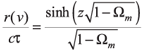
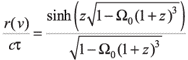
If we rewrite equation (22c) from ‘A creationist cosmology in a galactocentric
universe’,12 in terms of natural units and
for redshift (z) but arbitrary density (Ωm), which is the averaged
matter density of the universe expressed as a fraction of the ‘closure’
density, it becomes:
(1)
where r is the radial distance to the galaxy and c is the speed
of light.16 The parameter
is the time constant of the universe, a constant at any epoch and approximately
the reciprocal of the Hubble constant. It is related to a new constant in Carmeli’s
model h = 1/
, which is not redshift dependent.
Equation (1) is the Hubble relation, which, when taken for small redshift (z),
reduces to the Hubble Law. For small z the right-hand side (rhs) of (1)
is approximately z and the left-hand side (lhs) becomes H0/c.
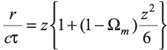
Expanding the rhs to the second term (using a power law approximation for sinh)
yields the equation used by Carmeli to predict the form of the high-z supernovae
measurements.17 (Equation 5.21 of ref.
18, which is reproduced here.)
where Ωm<1
(2)
Calculations show that (1) and (2) are nearly identical for z < 1. To make his
equation fit the high-z supernovae measurement data, Carmeli assumed a value of
matter density of Ωm = 0.245, which was the accepted value in 1998,
and corresponds to the presently accepted Ωm = 0.3 in the FL cosmologies.
This density is assumed to be made up of mostly dark matter.
But let us instead consider what happens to the density of matter as we look back
in time, when the universe was smaller. (When we look out into the cosmos at redshifted
light, we are looking backwards in time.) Carmeli assumed that the value of Ωm
was fixed in his curve fitting. However, Ωm varies as a function
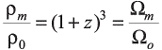
of z. For flat space it is normally assumed:
(3)
where Ρm(z) is the averaged matter density of the universe at the
redshift value z, and Ρ0 is the averaged matter density
of the universe locally or near z = 0. The parameter Ω0 is then
the locally averaged matter density of the universe expressed as a fraction of the
critical density. Here we assume only normal baryonic atomic matter. Equation (3)
results from the fact that as the redshift increases, the volume decreases as (1
+ z)3. Notice that at z = 1 the universe is 8 times smaller in volume
and therefore it is 8 times denser. That is, at z = 1, Ωm = 8 Ω0.
Substituting (3) into (1) we get:
(4)
Following the same approach as Carmeli, I have plotted (in figure 1) Carmeli’s
equation (1) with Ωm = 0.24 and my equation (4) with Ω0
= 0.03, which is within the bounds of the locally measured (z ≈ 0) value for
baryonic matter.19 Comparing the two
equations between z = 0.25 and z = 1, which is the critical domain of the analysis,
we get the following pairs of values for
shown in table 1.
Table 1. Comparison of redshift distance equations
From table 1 it can be seen that the difference between the two equations over the
domain of the measurements is much less significant than the fit to the data. The
supernovae distances measured were 10%–15% farther out than expected and many
points don’t touch the curve fit within 1 σ error bars. If we assume
Ω0 = 0.04 instead of Ω0 = 0.03, both of which
are within measured parameters, we get closer agreement at smaller redshift but
a poorer fit near z = 1.
Figure 3. The parameter ΩΛ plotted as a
function of Ωm. Note: the axis for Ωm has been
reversed, running from large to small.
From table 1 it is seen that a local matter density of only Ω0
= 0.03—0.04 is necessary to have good agreement with observation in the local
part of the universe. This, then, effectively eliminates the need for dark matter.
Using equation (24) from ‘A creationist cosmology in a galactocentric universe’,12 which is approximated for small z, Carmeli gives
a value for h = 80 km s-1 Mpc. This gives the time constant
= h-1 = 3.85 ×10¹⁷ s at this current epoch.
Dark energy
Carmeli’s cosmological model assumes20
that the expansion of the universe starts with Ωm >
1 and uses equation (1) to describe the expansion. The early expansion involves
a deceleration followed by a point where Ωm = 1 (coasting)
and then an accelerating expansion with Ωm < 1.
The FL model as sumes a homogeneous, isotropic universe. In order that the expansion
of the universe accelerates, the FL inflation cosmologies21
have had to return the cosmological constant, Λ, to Einstein’s field
equations to become:
(5)
By comparing his model with the standard FL model, Carmeli was able to determine
a value for the contribution of Λ to the mass/energy density of the universe,
though it does not explicitly appear in the Carmeli cosmology. This parameter ΩΛ
has often been called the contribution from the vacuum energy density and given
the parameter ΩΛ, when expressed as a fraction of the critical,
or ‘closure’, density. The critical density in the FL models is
, while in Carmeli’s model ρc
= 3h2/8πG. Thus, Carmeli
showed22 that ΩΛ
= (H0/h)2.
The WMAP value of H0gives a value of ΩΛ= 0.782 (at z = 1), where I have used the form of (4) with Ω0
= 0.03. Carmeli produced a similar result of ΩΛ = 0.764
when he used (24) from ‘A creationist cosmology in a galactocentric universe’
and Ωm = 0.245. 23
Hence, Carmeli showed ΩΛ + Ωm=
1.009 and reported that space was essentially flat-Euclidean geometry (see figure
4).
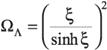
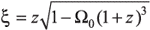
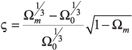
Taking this further, we get, for the fraction of dark energy,
where
(6)
Dark energy is also referred to as vacuum energy and (6) describes the evolution
of the fraction of this vacuum energy (ΩΛ) as a function
of redshift (z). This parameter ΩΛ represents a force that
pushes the galaxies outward, away from each other. In Carmeli’s model the
pressure
kg m-2 is positive, where Ωm < 1. It is not negative
as is required in FL and Gentry’s cosmologies.12
In FL cosmologies dark energy is interpreted as either vacuum energy (cosmological
constant) or as the slowly changing energy of a scalar field with a vacuum-like
equation of state p = w ρV, where the
parameter is model-dependent but usually w = –1. WMAP data indicates w
= –0.78.24 This is where Gentry
gets his negative mass term.
Remember, neither ΩΛ nor Λ appear explicitly in Carmeli’s
model. It is only by a comparison with FL models that the assignment can be made.
This means that dark energy is really a property of space-time, or more correctly
space-velocity as Carmeli calls it. By writing ΩΛ
as a function of z we can get an idea of its behaviour over time (figure 2).
As we look back in time in the cosmos the matter density increases according to
(1 + z)3. So we see the effect on ΩΛ,
though (6) may not be valid for Ωm + ΩΛ
>> 1 because of the assumption in (3). Equation (7), however, should remain
valid, although we don’t know how the density varies at high redshift. Figure
2 shows both the values of ΩΛ, Ωm and ΩΛ
+ Ωm as a function of redshift, z. The parameter ΩΛ
starts at the origin with the value of unity and as z increases and density increases,
ΩΛ initially decreases but then starts to grow rapidly past
z = 1.5. At a redshift of z = 1 this model yields ΩΛ = 0.78,
Ωm = 0.24 and ΩΛ + Ωm
= 1.02.
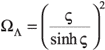
Obviously, this analysis is still limited by the assumptions in (3) but if we eliminate
z from (6) by writing
we get:25
where
(7)
In figure 3, I have plotted ΩΛ as a function of Ωm
from (7). It indicates that as the mass/energy density increases, ΩΛ
becomes extremely large. This means as we look back into the past towards the creation
at the beginning of Day 4, when God stretched out the heavens, we see a very large
cosmological constant contribution or vacuum energy density, which decreases with
time running forward. This may be interpreted to mean that God gave the expansion
a big boost at the beginning to overcome the initial tendency for matter to collapse
on itself instead of expanding. It is important to reiterate that these effects
are properties of the correct field equations, which I see are the descriptions
of God’s actions and laws in the universe.
From (6) and (7) it follows that as the universe expands the total density tends
to a vacuum energy density ΩΛ = 1 (since Ω0
= 0). This means a totally spatially flat universe in a totally relaxed state. In
figure 3 as Ωm → 0 we see ΩΛ
→ 1, but in the form of a damped oscillation as seen in relaxation mechanisms.
The Ωm axis has been reversed to indicate the direction (towards
the right) of the flow of time as the universe expands.
For small z the total density becomes
(8)
It follows from (8) that for Ω0 = 0.03 as z → 0 the total
density ΩΛ + Ωm → 1.03. This result
is consistent with the WMAP cosmic microwave background data that produced a value
of Ω m = 1.02 ± 0.02.26
(Note that they considered it is all due to matter.) However, it follows from (3)
and (8) that the universe will always be open, Ωm < 1 as it
expands. The value of the total density ΩΛ + Ωm
begins very large but is always greater than unity and as the universe expands ΩΛ
asymptotically decreases as it approaches unity. Therefore, the universe expands
to become asymptotically spatially flat, i.e. ΩΛ
+ Ωm → 1.
Carmeli concluded from (1) that the universe was infinite and curved. Because the
present value of Ωm < 1, the universe must be negatively
curved and infinite. But this conclusion is not necessitated by the equations, since
they describe an isotropic, not homogeneous, centro-symmetric matter distribution.
Different interpretations are applied by different commentators on this. The figure
for total energy density ~1.02 from the WMAP data is in agreement with this analysis,
even though the WMAP calculation is model-dependent, and the comparison may not
be really valid. Both standard big-bangers and Carmeli would agree that spatially
the universe is flat or nearly flat.
Image by NASA/WMAP Science Team Figure 4. Spatial curvature for closed (Ω0 >
1), open (Ω0 < 1) and flat, or Euclidean, (Ω0
= 1) space
But since the cosmological constant is a property of space-time-velocity
in the Carmeli cosmology the value of Ωm determines the
state (open or closed) of the universe. Initially, adherents to FL cosmology had
believed the universe was slightly closed and expanding towards a flat state, but
the high-z supernovae and WMAP observations changed that. According to the Carmeli
model, the data indicate that space is now slightly open but accelerating towards
a spatially flat state. See figure 4 for a graphical definition of open,
flat (Euclidean) and closed spatial curvature.
A creationist cosmological interpretation based on Carmeli’s model is a finite
universe with spatial curvature that is essentially Euclidean. In the past this
was not the case as the concentration of matter curved space, but all that took
place in the first few days of the Creation Week. Since equation (1) indicates that
the universe (actually space-velocity) passed through three phases, from
closed to open through the momentary flat space-velocity,
it necessitates a finite and bounded universe. How can a closed finite universe
become an open infinite universe? Here the creationist finite and bounded universe
makes sense.
The accelerating power of the universe is God himself. Therefore, He is behind the
cosmological constant. It is not the result of dark energy, but God’s Almighty
power as he gave impetus to the universe. The parameter appears in the standard
FL inflationary cosmologies because they have to add it to account for the observed
effect. Carmeli more correctly constructed his model without a need for this parameter
by describing the mass/energy tensor such that as the universe expands, the vacuum
of space itself relaxes. It can be understood that as the universe expands, the
total density tends to a vacuum energy density ΩΛ of unity
(since Ω0 tends to zero). This means a totally flat universe in
a totally relaxed state. It is as if the fabric of space itself has relaxed like
the relaxing of a coiled spring.
Conclusion
The cosmological general relativity of Carmeli can explain the expansion of the
accelerating universe without the need to resort to dark matter. By making a reasonable
assumption about the dependence of matter density on redshift, it is shown that
dark matter can be eliminated completely from the universe .
As in past centuries, dark matter has been invoked to account for motions that could
not be explained with the then-known laws of physics. General Relativity was applied
to the motion of the planets to solve the riddle of the advance of the perihelion
of Mercury.1 There still remains the alleged dark
matter found in halos around spiral galaxies. That is outside the scope of this
paper, but Milgrom’s MOND27 is
a good empirical fit28 and Carmeli’s
new equations of motion offer a solution there also.29
The modified field equations used by Carmeli describe a universe that would be expected
from a reading of the Bible. That is, a galactocentric universe—the Milky
Way galaxy being at the centre of the universe. The equations don’t explicitly
involve a dark energy or a cosmological constant term, but they describe the present
visible universe very well. They tell us the universe is accelerating and an extrapolation
describes a state in the past where the universe was given a big push to expand
out to its present locations. The cosmological constant, or dark energy, really
describes a property of space-velocity. The big push was
God, but through the agency of the fabric of space itself. He is the unseen force
in the universe. God designed the original creation in a state such that it would
naturally expand, relaxing the fabric of space itself like an uncoiling spring.
Posted on homepage: 28 September 2006
References and notes
Alternative explanations have included massive compact halo objects
(MACHOs) which are made of normal baryonic particles (electrons, neutrons and protons),
which may be observable, but are difficult to see. This idea is not as popular,
as according to big bang theory not enough baryonic particles were made to account
for the missing mass problem by MACHOs alone. Return to text.
See web page: <astrosun2.astro.cornell.edu/academics/courses/astro201/merc_adv.htm>,
October 2004, which explains the advance of the perihelion of Mercury. ‘The
theory of relativity predicts that, as it orbits the Sun, Mercury does not exactly
retrace the same path each time, but rather swings around over time. We say, therefore,
that the perihelion—the point on its orbit when Mercury is closest to the
Sun—advances. In the diagram shown here, the amount of the advance is greatly exaggerated.
The actual advance is only 43 seconds of arc per century.’ See graphic at
the same address. Return to text.
Riess, A.G., Filippenko, A.V., Challis, P., Clocchiatti, A. and
Diercks, A., Observational evidence from supernovae for an accelerating universe
and a cosmological constant, Astron. J. 116:1009–1038,
1998. Return to text.
Garnavich, P.M. et al., Constraints on cosmological models
from Hubble space telescope observations of high-z supernovae, Bulletin of the American
Astronomical Society 29, 1997. Return to text.
Garnavich, P.M. et al., Constraints on cosmological models
from Hubble space telescope observations of high-z supernovae, Astrophys. J. 493:L53–L57, 1998. Return to text.
Perlmutter, S. et al., Cosmology from type ia supernovae:
measurements, calibration techniques and implications, Bulletin of the American
Astronomical Society 29:1351, 1997. Return to text.
Perlmutter, S. et al., Measurements of Ω and Λ
from 42 high-redshift supernovae, Astrophys. J. 517, 565–586,
1999. Return to text.
Hartnett, J.G., Cosmologists can’t agree and still are in
doubt, Journal of Creation 16(3):21–26, 2002. Return to text.
Humphreys, D.R., Starlight and Time, Master Books, Colorado
Springs, CO, pp. 14–18, 1994. Return to text.
Carmeli, M., Cosmological Special Relativity, World
Scientific, Singapore, 2002. Return to text.
The standard paradigm is the hot big bang inflationary cosmology.
Carmeli is not a believer in God, and I am not suggesting his cosmology was constructed
with the creationist model in mind. Return to text.
Hartnett, J.G., A creationist cosmology in a galactocentric universe
Journal of Creation 19(1):73–81, 2005. Return to text.
Carmeli, M., Cosmological relativity: Determining the universe
by the cosmological redshift as infinite and curved, Int. J. Theor. Phys. 40:1871–1874, 2001. Return to text.
Hartnett, J.G., Carmeli’s accelerating universe is spatially
flat without dark matter, in press, Int. J. Theor. Phys. <
arxiv.org/ftp/gr-qc/papers/0407/0407083.pdf>, October 2004. Return to text.
In (1) and subsequent equations v/c = z
is used for the velocity of the galaxies in the expanding universe. For velocities
v ~ c a relativistic form v/c ={ (1+z)2 -1}/ {(1+z)2
+1} may need to be used if the expansion is speed limited. This must be determined
experimentally. Return to text.
He had previously predicted the accelerating universe in 1996.
See Carmeli, M., Cosmological general relativity, Commun. Theor. Phys.
5 :159, 1996. Return to text.
Behar, S. and Carmeli, M., Cosmological relativity: A new theory
of cosmology, Int. J. Theor. Phys. 39:1375–1396,
2000. Return to text.
Fukugita, M., Hogan, C.J. and Peebles, P.J.E., The cosmic baryon
budget, Astrophys. J. 503:518–530, 1998. Return to text.
This was a deduction based on equation (1) and the estimated
matter density at the time Carmeli published in 1996. He included dark matter in
that matter budget. This paper and ref. 15 show that no dark matter is necessary.
Hence Ωm, instead, is determined only from the current local density
of matter, i.e. the value of Ωm measured to be approximately somewhere
between 0.007 and 0.041, with a best estimate of 0.021. See ref. 19. Return to text.
<map.gsfc.nasa.gov/m_uni/uni_101bb2.html>, October 2004.
Return to text.
This was the value published in Riess et al. ,
ref. 3, so Carmeli chose this. Return to text.
<astrosun2.astro.cornell.edu/academics/courses/astro201/cosmoparms.htm>,
October 2004 and <lambda.gsfc.nasa.gov/product/map/wmap_parameters.cfm>, October
2004. Return to text.
If the relativistic velocity v/c ={ (1+z) 2 -1}/ {(1+z)
2 +1} applies as mentioned in footnote 16, then the correct form of the
expression here is
Return to text.
<map.gsfc.nasa.gov/m_uni/uni_101bb2.html>, November 2004.
Return to text.
Worraker, B.J., MOND over dark matter? Journal of Creation 16(3):11–14,
2002. Return to text.
Sanders, R.H. and McGaugh, S.S., Modified Newtonian dynamics
as an alternative to dark matter, Annu. Rev. Astron. Astrophys. 40:263–317,
2002. Return to text.
Carmeli, M., Is galaxy dark matter a property of spacetime?
Int. J. Theor. Phys. 37(10):2621–2625, 1998. See also
Hartnett, J.G., Can the Carmeli metric correctly describe spiral galaxy rotation
curves? <arxiv.org/ftp/gr-qc/papers/0407/0407082.pdf>, January 2005. Return to text.
Comments are automatically closed 14 days after publication.
Feedback Guidelines
Be constructive & courteous. Don't attack individuals, denominations, or other organizations.
Stay on-topic. We're not here to debate matters like eschatology, baptism, or Bible translation.
Links to external sites and articles will be removed from your submission.
Privacy & Content Ownership
Comments become the property of Creation Ministries International upon submission and may be edited for brevity and clarity.
CMI may choose not to publish your comment depending on how well it fits the guidelines outlined above.
By submitting your comment you are agreeing to receive email updates from Creation Ministries International. You may unsubscribe at any time.
CMI records your real name, email address, and country as a sign of good faith. Privacy Policy
If your comment is published, your name will be displayed as ""
Cancel
Accept & Continue
Close
You are leaving CREATION.com
We have supplied this link to an article on an external website in good faith. But we cannot assume responsibility for, nor be taken as endorsing in any way, any other content or links on any such site. Even the article we are directing you to could, in principle, change without notice on sites we do not control.














Readers’ comments
Comments are automatically closed 14 days after publication.