

The Yellowstone petrified forests
Evidence of catastrophe

Yellowstone National Park, the oldest national park in the United States, spans parts of three states: Wyoming, Montana, and Idaho. It is famous for its geothermal activity, including 10,000 hot springs and 200 geysers, including ‘Old Faithful.’ There are also mountains, including one of black obsidian (volcanic glass), cooled and hardened basalt lava flows, deep valleys and canyons, rivers, lakes, forests, petrified wood (wood turned into rock), and wildlife.
Petrified forests?
In some places in Yellowstone Park, erosion of a hillside reveals layers of upright petrified trees. At Specimen Ridge, there are said to be 27 layers, while Specimen Creek contains about 50. This means that the Specimen Creek formation is especially huge—its total vertical height is 1,000 meters (3,400 feet). This raises the question: how did the petrified tree layers form?
The evolutionist explanation
Evolutionists and other long-agers usually teach the following scenario:
Each layer is the remains of a forest.
Each forest was buried where it grew by volcanic ash and other debris.
Dissolved minerals were soaked up by the trees, petrifying them.
After about 200 years, the ash weathered into clay, then into soil.
A new forest grew on top of where the previous one had stood. From the well-preserved tree rings, the oldest tree in each layer was about 500 years old on average.
The new forest was buried by volcanic ash, and the process repeated.
The entire stack of layers was eroded, such that their edges are now exposed in a cliff (see diagram on the right).

If this scenario were true, it would have taken nearly 40,000 years to form the entire series at Specimen Creek. However, since this scenario is based on the unobservable past, it is not part of normal (operational) science, as this deals with repeatable observations in the present. But as we will see, there are certain features of Specimen Ridge that make no sense under this explanation.1

Problems with the long-age scenario

Growing trees have extensive root systems, usually 20–30% of the total dry mass of the tree. But the Yellowstone petrified trees have their large roots broken off, leaving ‘root balls.’ This happens when trees are forcefully pushed out of the ground, e.g. by a bulldozer.
A forest buried in place would be expected to have many petrified branches and much petrified bark. But the Yellowstone petrified tree trunks, mostly 3–4 meters (10–12 feet) tall, have very little bark and very few branches. Something has stripped most of the bark and broken off most limbs, leaving only knots in the trunks.
Some of the trees extend into the ‘forest’ layer above. But if the next layer had to wait hundreds of years for the ash covering to weather into soil (so the ‘next’ forest could grow), then the exposed tree top would have completely decayed. But if the trees were all laid down quickly, this observation should not be surprising.
When trees fall in forests, especially with a flat floor, they have an equal chance of lying in any direction. But in the petrified ‘forests,’ the prostrate (lying down) trees tend to align in the same direction. Also, even the upright trunks are turned so their long axis is aligned the same way. This is consistent with a common force, e.g. moving water or mud, having acted on both after they were uprooted.
If the layers had been buried by volcanic eruptions thousands of years apart, the mineral content of each would probably have been quite different. But the mineral content remains the same throughout over a kilometer of vertical height. This suggests one or few volcanic episodes, with many pulses within each episode, all within a fairly short time frame.
Growing forests have definite soil and humus layers, with lots of rootlets as well as a thriving animal population. However, the petrified ‘forests’ lack all these.
Studies of the Yellowstone plants, including pollen analysis, show that there are many more plant species than would be expected in a forest. And often the pollen doesn’t match the nearby trees. However, this would be explainable if the trees had been uprooted and transported from several places.
In a real forest, plant debris forms an organic layer on the forest floor. The deeper the material, the older it is, so the more time it has had to decay. But the petrified forests lack this pattern of greater decay with depth. There are also finely preserved leaves—since leaves do not retain their shape for very long after they fall off the tree, these leaves were probably buried very quickly.
Volcanic minerals such as feldspars quickly weather into clay when exposed to water and air. But the petrified ‘forest’ layers lack clay. This suggests that none of the layers were exposed for very long.
The patterns of particle sizes in rock layers often indicate how they formed. Consider a bag of mixed nuts—often they will be randomly mixed. Or, if they are shaken, the large brazil nuts end up on top as the smaller nuts fall down through the gaps. But many rock layers which have been laid under water show patterns different to these. The large grains have sunk to the bottom, and been covered by smaller grains—a pattern called graded bedding. Also, if the water is moving horizontally, alternating layers of coarse and fine grains form.2,3,4,5 The Yellowstone ‘forests’ are associated with rocks which contain these laminations, consistent with being formed under water. Some beds of coarse material have tongues of ash penetrating them. Also, such flat beds would seem to require a lot of water so the material can flow over such large distances. Some volcanic rocks in New Zealand that are generally accepted to have been deposited under water look very similar to the Yellowstone rocks.1
Under normal circumstances, a tree adds a growth ring every year. The thicker the ring, the faster the tree grew in that time, and this depends on the weather, among other factors. So trees growing at the same time and roughly in the same area should show matching patterns of thick and thin rings. On the other hand, trees growing hundreds of years apart would show different patterns. Because he believed the biblical framework, geologist Dr John Morris predicted in 1975 that trees in different layers of the Yellowstone formations would have matching patterns, rather than completely different ones.6
Years later, Dr Michael Arct analyzed cross-sections of 14 trees in different levels spanning seven meters (23 feet). He found that they all shared the same distinctive signature, and that four of them had died only seven, four, three and two years before the other ten. These ten had apparently perished together, and the evidence was consistent with them all having been uprooted and transported by successive mud flows.7
New explanation needed

As shown above, the slow ‘one after the other’ explanation for the Yellowstone petrified trees is incompatible with the evidence. It also clearly contradicts a straightforward reading of Scripture which teaches a young age for the earth (see How long were the days of Genesis 1? and Six Days?—Honestly! at christiananswers.net). We weren’t there to see it happen, and we should not trust such scenarios when they contradict God’s infallible written Word. Starting from a biblical framework, we should expect that the ‘forests’ were buried recently, and probably by a catastrophe.
A recent catastrophe has given us some insight into what might have produced the Yellowstone petrified ‘forests.’ On 18 May, 1980, Mt St Helens in Washington State erupted with the energy of 20,000 Hiroshima bombs. Although tiny by the standards of most eruptions, this eruption flattened millions of trees in 625 square kilometers (240 square miles) of forest. The eruption also melted snowfields and glaciers, and caused heavy rainfall. This resulted in a mudflow that picked up the fallen logs (some of which traveled upright), so that both forks of the Toutle River were log-jammed. An earthquake, Richter magnitude 5.1, caused a landslide that dumped half a cubic kilometer (one-eighth of a cubic mile) of debris into the nearby Spirit Lake. This caused waves up to 260 meters (860 feet) high, which gathered a million logs into the lake, forming a floating log mat (see above). Most of them lacked branches, bark and an extensive root system.
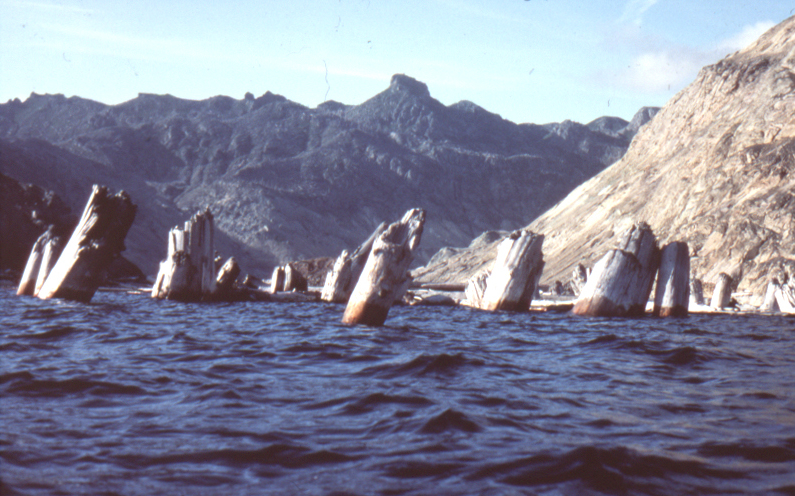
Since roots are designed to absorb water, the remains of the roots on the floating logs soaked up water from the lake. This caused the root end to sink, and the log tipped up to float in an upright position (see right). When a log soaked up even more water, it sank and landed on the lake bottom. Debris from the floating log mat and a continuing influx of sediment from the land (in the aftermath of the catastrophe) buried the logs, still in an upright position. Trees that sank later would be buried higher up, that is on a higher level, although they grew at the same time. This was confirmed by sonar and scuba research by a team led by Drs Steve Austin and Harold Coffin.8,9 By 1985, there were about 15,000 upright logs on the bottom. Later, the lake was partly drained, exposing some of the bottom, revealing upright logs stuck in the mud (see photo on p. 21 of the magazine).
There is ample evidence that petrifaction need not take very long. Hot water rich in dissolved minerals like silica, as found in some springs at Yellowstone, has petrified a block of wood in only a year.10
Imagine if the logs on the bottom of Spirit Lake were found thousands of years later. Evolutionists would probably interpret them as multiple forests buried in place, rather than trees living at the same time that were uprooted, transported, and then sunk at different times.
Why does it matter?
One historian of science, Ronald Numbers, placed his faith in fallible human theories about the past, and used this as an excuse to apostatize (fall away from his professed faith). As he said in his book on the history of creationism,11,12
‘I vividly remember the evening I attended an illustrated lecture on the famous sequence of fossil forests in Yellowstone National Park and then stayed up most of the night … agonizing over, then accepting, the disturbing likelihood that the earth was at least thirty thousand years old. Having thus decided to follow science rather than Scripture on the subject of origins, I quickly, though not painlessly, slid down the proverbial slippery slope toward unbelief.’13
Of course, he was not following ‘science,’ in the sense of repeatable observations in the present; that is, the type of science that sent men to the moon.
More importantly, he presumed that he knew all the facts, which he obviously did not. We should remember the lesson of ‘Piltdown man.’ Before the hoax was discovered in 1953, this convinced many that evolution was true. Those convinced included the eminent English Christian surgeon Arthur Rendle Short, who unlike Ronald Numbers never apostatized. But Rendle Short agonized over long ages of death and suffering, which clearly conflict with the biblical teaching that there was no death before the Fall Genesis 1:29–30, 3:19; Romans 5:12; 1 Corinthians 15:21–22).14 There is evidence that his view was moving back to biblical creation, although he didn’t quite live to see ‘Piltdown man’ exposed as a hoax.
We now have answers to both the Piltdown and Yellowstone challenges. We should remember, if confronted with other ‘unanswerable’ challenges to the biblical world view, that even if we don’t have all the answers, God does. And He, in His good time, may raise up godly scientists to discover them.
Re-posted on homepage: 21 February 2018
References and notes
- Much information comes from Harold Coffin (with Robert Brown), Origin by Design, Review and Herald Publishing Association, Washington DC, 1983. Return to text.
- Batten, D, Sandy stripes: Do many layers mean many years? Creation 19(1):39–40, 1996; creation.com/sandy. Return to text.
- Julien, P., Lan Y., and Berthault, G., Experiments on stratification of heterogeneous sand mixtures, J. Creation 8(1):37–50, 1994; creation.com/sandstrat. Return to text.
- Berthault, G., Experiments on lamination of sediments, J. Creation 3(1):25–29, 1988; creation.com/sedexp. Return to text.
- Makse, H.A., Havlin, S., King P.R. and Stanley, H.E., ‘Spontaneous stratification in granular mixtures’, Nature 386(6623):379–382, March, 1997. See also Snelling, A., Sedimentation experiments: Nature finally catches up! J. Creation 11(2):125–126, 1997; creation.com/sednature. Return to text.
- Morris, J., The Young Earth, Master Books, Colorado Springs, CO, pp. 112–117, 1994. Return to text.
- Arct, M.J., ‘Dendroecology in the fossil forests of the Specimen Creek area, Yellowstone National Park’, Ph.D. Dissertation, Loma Linda University, 1991; Dissertation Abstracts International 53-06B:2759, 1987–1991. Return to text.
- Austin, A., Mount St Helens and catastrophism, Proceedings of the First International Conference on Creationism, 1:3–9, ed. R.E. Walsh, R.S. Crowell, Creation Science Fellowship, Pittsburgh, PA, USA, 1986; Ham, K., ‘I got excited at Mount St Helens!’ Creation 15(3):14–19, 1993; creation.com/excited. Return to text.
- Coffin, H.G. , Mt St Helens and Spirit Lake, Origins (Geoscience Research Institute) 10(1):9–17, 1983. Return to text.
- Sigleo, A.C., Organic chemistry of solidified wood, Geochimica et Cosmochimica Acta 42:1397–1405, 1978; cited in J. Morris, ref. 6, p. 113. Return to text.
- Numbers, R., The Creationists: The Evolution of Scientific Creationism, University of California Press, 1992. Return to text.
- Although well-researched, his prejudices are evident. The book majors heavily on personalities, with subtle (and some not-so-subtle) character assassinations, while the high scientific qualifications of many creationists are downplayed. He invariably gives the last word to the evolutionist, which often leaves an impression contrary to the facts as can be seen upon checking the sources. However, he exposes the ‘strained efforts’ of re-interpreting Scripture to fit evolution, and the deceit of some theistic evolutionary college professors ‘[s]tretching the truth to the breaking point’ (p. 182) when trying to hide what they really believed from conservative parents and donors. See also review by Prof. Edgar Andrews, Origins (Journal of the Biblical Creation Society) 8(20):21–23, 1995. Return to text.
- Numbers, R., Ref. 11, p. xvi. Return to text.
- See the book by his son, Prof. John Rendle-Short, Green Eye of the Storm, Banner of Truth Trust, Edinburgh, 1998, Part 3; and the shorter account From theistic evolution to creation, Creation 19(2):50–51, 1997; creation.com/rendle-short. Return to text.



Readers’ comments
Comments are automatically closed 14 days after publication.