
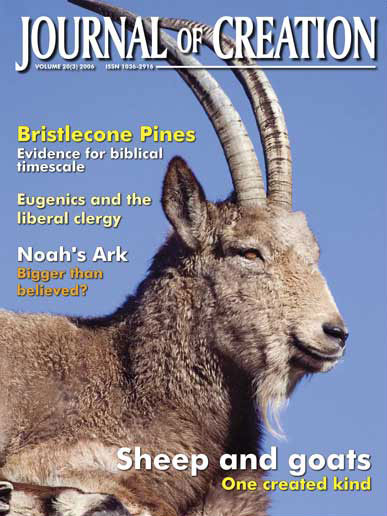
Journal of Creation 20(3):61–65, December 2006
Browse our latest digital issue Subscribe
Identification of species within the sheep-goat kind (Tsoan monobaramin)
The Bible teaches that animals were created according to their kind with the ability to reproduce. It also states that God intended for them to fill the earth so it would be inhabited. Since variations in climate exist, it follows that God would provide animals the ability to adapt so this could be accomplished. Both biblical and hybrid data indicate that sheep (Ovis aries) and goats (Capra hircus) belong to a monobaramin (or basic type, a group belonging to the same kind). Further hybrid data indicate that other species in the genera Ovis, Capra, Ammotragus, Hemitragus and probably Rupicapra fall within this monobaramin as well. An alleged hybrid between sheep and European roe deer suggests that this monobaramin may actually include several ruminant families; however, a better documented example is desirable before reaching strong conclusions. The variation seen within this monobaramin, at least some of which are adaptive changes, indicate that mutation and chromosomal rearrangement have contributed to the development of currently existing species.
* Terms marked with an asterisk are defined in the Glossary at the end of this article.

From the Bible’s history it is clear that God made living things according to their kinds. These kinds were created to reproduce and fill the earth.1 At the time of the Flood, some of each kind of terrestrial and flying animal were brought on board the ark so that they could be preserved.2 Afterward, they were to reproduce and again fill the earth.3 Many creationists believe that after the Flood there were dramatic changes in climate. This was also a time of rapid speciation as animals spread out over the earth and adapted to new environments. Although animals reproduce within their own kind, characteristics of different populations eventually became divergent enough that they were given different names.4 This concept that creatures were designed by God according to their kind and with the ability to adapt5 is in contrast with the molecules-to-man evolutionary idea that all organisms had a single common ancestor and adaptation is the result of chance events.
The study of created kinds is called baraminology (from Hebrew bara: create, min: kind). One tool used to determine if two different species belong in a monobaramin (a group belonging to single kind) is to see if they can hybridize with each other or if they can both hybridize with a third species.6 While such interspecific hybridization* clearly identifies two species as belonging to the same baramin, the absence of such hybridization data is not in itself conclusive.7 There are a number of differences that can naturally arise between populations that may result in hybridization failure.8 This study will examine data relating to the baraminic classification of sheep and goats and some of the variation that exists within this monobaramin.
The biblical record
The Bible is not primarily a book about biology. However, it is completely true in all that it presents. It is therefore critical for Christians to base their beliefs in all areas of life upon the Bible. This includes our understanding of history and biology. One of the earliest mention of an animal in the Bible is found in Genesis 4:2, 4 where it tells of the animals Abel kept and brought to God as a sacrifice. Often rendered ‘flock’, the Hebrew word צאן (tsō’n) refers to a group of domestic sheep and/or goats. It is used a total of 275 times in the Old Testament.9Since it is first used so early in history, long before the Flood, it seems reasonable to believe that it referred to a baramin. However, it is not yet clear how this baramin corresponds to animals in our modern classification system, so for the purpose of this paper it is referred to as the Tsoan* monobaramin.
There are a variety of other terms used in the Bible for an individual sheep or goat. The Hebrew word שה (śeh), usually translated lamb, can refer to an individual of either species.10 Other words may imply things about the gender, age or species of the animal. However, they are used after the Flood and don’t appear to be helpful in determining baraminological relationships. One possible exception is the Hebrew יעלה/יעל(yā‛ēl/ya‛a lâ) which refers to a wild goat, specifically the Nubian ibex (Capra nubiana). It only occurs four times in the Old Testament, but two of those times (Job 39:1; Proverbs 5:19)11 it is compared with the Hebrew אילה/איל (’ayyāl/’ayyālâ) meaning deer/doe. This indicates a similarity was recognized between wild goats and deer. However, this in itself is not sufficient to conclude that they belong to the same monobaramin. Indeed, in Psalm 104:18 the wild goat is mentioned in parallel structure with a coney (hyrax or rock badger), although the context of the later places the emphasis on the similarity in habitat rather than in the creatures themselves.
Hybridization data
Domestic sheep (Ovis aries) and goats (Capra hircus) have been closely associated throughout history. Even today there are many places where they are kept together. Although it is not uncommon to see them mating under these circumstances, live offspring from such a mating are extremely rare. Several hybrids have been confirmed using chromosomal analysis to demonstrate that they had 57 chromosomes (2n = 57) which is intermediate between goats (2n = 60) and domestic sheep (2n = 54) (table 1).12 One study reported a 96% fertilization rate when goats were mated (a buck* with a doe*), and a 90% fertilization rate when sheep were mated (a ram* with a ewe*). However, when rams were crossed with does there was a 72% fertilization rate and the embryos died at 5 to 10 weeks. When bucks were crossed with ewes there was a 0% fertilization rate.13 Thus, the few well documented live hybrids confirm that sheep and goats do both belong to the Tsoan monobaramin. The study cited illustrates how differences have developed within this baramin that most commonly result in a poor fertilization rate and/or a high spontaneous abortion rate in matings between sheep and goats.
Within the genus Ovis hybridization occurs quite readily. In fact this is one reason why the species listed in this genus vary depending on the source.14 The mouflon, wild sheep previously classified as O. musimon or O. orientalis, are now often classified as O. aries along with domestic sheep.15 Fertile offspring have been observed from crosses between domestic sheep and the mouflon. Fertile offspring have also been documented between these sheep and Argali sheep (O. ammon, 2n = 56), the Urial (O. vignei, 2n = 58), and bighorn sheep (O. canadensis, 2n = 54).16 It is worth noting that within this genus, differences in chromosome number do not pose a barrier to hybridization.
Attempts to artificially cross domestic sheep with the chamois (Rupicapra rupicapra, 2n = 58) resulted in hybrid embryos which died. Similar attempts to cross sheep with domestic cattle (Bos taurus, 2n = 60) resulted in 11 out of 51 sheep eggs cleaving when fresh bull semen was introduced. However, fertilization and cleavage are not sufficient to classify two organisms within the same monobaramin. It is necessary for embryogenesis to continue past the initial maternal phase and for there to be coordinated expression of both paternal and maternal genes.17 Finally, there has been an alleged hybridization between domestic sheep and European roe deer (Capreolus capreolus, 2n = 70).16 European roe deer belong to the family Cervidae, which are characterized by their bony, branched antlers that are shed annually. All other animals previously mentioned in this section belong to the family Bovidae, which are characterized by unbranched horns consisting of a bony core, covered by a keratinized sheath and are not shed.18
Domestic goats can hybridize with the Alpine ibex (C. ibex), Nubian ibex (C. nubiana), Siberian ibex (C. sibirica), Markhor (C. falconeri), West Caucasian or Kurban tur (C. caucasica), East Caucasian or Daghestan tur (C. cylindricornis), and Barbary sheep (Ammotragus lervia, 2n = 58). Many of the hybrids within the genus Capra are fertile. Crosses between domestic goats and the Himalayan tahr (Hemitragus jemlahicus, 2n = 48) have resulted in abortions, but no live young. Hybrids between goat and the chamois (Rupicapra rupicapra) have been reported, but a further attempt to produce a hybrid failed.16
Inferences from other data
Within the genus Ovis there are two species for which no clear hybrid data were found. These are Dall’s sheep (O. dalli, 2n = 54) and the snow sheep or Siberian bighorn (O. nivicola, 2n = 52). Both these species are considered to be very closely related to bighorn sheep (O. canadaensis).19 They are mountain sheep which are similar in morphology, habitat, and chromosome number.

Within the genus Capra there are also two species for which no clear hybrid data were found. These are the Spanish ibex (C. pyrenaica) and the Eithiopian or Walia ibex (C. walie). These species are closely related to the other ibexes which were all classified as subspecies of C. ibex at one time. As with sheep, there is still controversy over definitions of species and subspecies. The Walia ibex is often included with the Nubian ibex.20 Since the few species that lack hybrid data are considered so closely related to a species linked by hybrid data, it seems reasonable to conclude that all species of Ovis and Capra fall within the Tsoan monobaramin.
Additionally, animals within the same genus would be expected to be more closely related to each other than animals from different genera. Thus, even if there had been no further information on the Ovis or Capra species that lacked hybrid data, it would still seem reasonable to assume that they belong within the monobaramin. When hybrid data shows animals from different genera to be monobaraminic, all animals within the two genera would be expected to be in the monobaramin.
Variation within Tsoan
Once animals have been identified as belonging to the same monobaramin, variation within the monobaramin can be examined for patterns. There is tremendous variation found within Tsoan (figure 1). For example, horns in sheep generally curl at the side of the head as they grow. Normally there is only one pair of horns, but Jacob sheep (a domestic breed) may have two or even three pairs. Those with four horns have two vertical centre horns that may be up to several feet long (much like goat horns), and two lateral horns which curl down along the side of the head.21 Goat horns tend to grow upward, and somewhat outward and backward. In some Capra species the horns of adult males22 form a very large semi-circle as viewed from the side.23 However, the Markhor has tightly curled corkscrew-like horns,24 while the Daghestan tur has horns which are a rounded triangle shape on cross-section that make an open curl over the head (much like a lyre as viewed from the front of the animal when its head is slightly lowered). Horns in males are usually much larger than those in females.25 Some breeds of domestic sheep are naturally polled*. Thus, there is considerable variation in the size, shape, and number of horns within this monobaramin.
The pelage or hair coat of Tsoan is also highly variable. Typically mammals have guard hairs which overlay and protect the underfur. The underfur may be composed of wool, fur and/or velli.26 Domestic sheep are best known for having well developed wool, a growth of underfur that is not shed, and very few guard hairs. This wool ranges from the fine (narrow diameter) wool of the Merino to the longer, coarser wool of the Jacob sheep. Some domestic sheep and most domestic goats have no obvious wool. The length of hair may also vary according to the species, gender and body region of the animal. Bucks often have a beard. Rams in some species have a mane, a fringe of long hair under the throat that runs down to the brisket. In Barbary sheep, the mane divides at the brisket and continues down the legs as chaps.27 In addition to variation in type, diameter and length of hair fibres, there is variation in colour, colour pattern and density of the hair coat.
There is considerable homology among the sheep, goat, and cattle genomes. Both goats and cattle have 60 chromosomes consisting of 29 pairs of acrocentric* autosomes*. Domestic sheep have 3 less chromosome pairs relative to goats and cattle, including 23 pairs of acrocentric and 3 pairs of metacentric* autosomes. Sheep chromosome (OAR) 1 is considered equivalent to goat (CHI) and cattle (BTA) chromosomes 1 and 3. OAR 2 corresponds to CHI/BTA 2 and 8, and OAR 3 to CHI/BTA 5 and 11. These differences are attributed to three Robertsonian translocations.28 A Robertsonian translocation occurs when the long arms of two nonhomologous acrocentric chromosomes combine to form a single chromosome.29 This is a relatively common type of chromosomal change which is nonrandom and appears to have distinct mechanisms that drive the change.30
Conclusions
All species in the genera Ovis, Capra and Ammotragus are clearly within Tsoan. Hemitragus is also included because identifiable abortions indicate a significant amount of embryonic development has taken place. Rupicapra is probably included; it appears the major reason for doubting the authenticity of the alleged hybrids with goats was because an additional attempt failed. However, failure is the most common result when goats are crossed with sheep. It is unclear how far the embryos developed when Rupicapra was crossed with sheep. A better documented hybrid would remove the uncertainty. These five genera all fall within Caprinae, a subfamily within the family Bovidae.
Although similarities between Tsoan and cattle have been noted, there is currently insufficient hybrid data to place cattle within Tsoan. Cattle belong to Bovinae, a separate subfamily within the family Bovidae. Yet, the alleged hybrid between sheep and European roe deer suggests Tsoan may include not only the family Bovidae, but also the family Cervidae. If this is verified, then Tsoan would likely include Antilocapridae, a family consisting of only the pronghorn (Antilocapra americana) which is intermediate between Cervidae (consisting of over 40 species) and Bovidae (consisting of nearly 140 species). Other ruminant families may be included as well. A better documented Bovidae/Cervidae or other interfamilial hybrid would be tremendously helpful in ascertaining the true baraminological relationship of these families. Since well documented hybrid data is lacking at this time, cattle hybrids will be examined separately in a subsequent paper.
The variation present within the Tsoan monobaramin is from both the variety created in this baramin initially and changes that have been acquired throughout history. Some characteristics naturally change as a result of environmental changes, for example growth of a heavier winter coat and moulting. However, the variation within the monobaramin far exceeds this. Mutations, any acquired change within the genome, have historically been considered to be due to random copying errors. As such, they do not significantly add information and often result in disease. However, within the last several decades evidence has been found that some changes within bacterial genomes are directed. Such mutations can be initiated by environmental signals which allow changes in a part of the genome that is likely to help the organism adapt.31 Much of the variation in pelage could be attributable to similar changes.32 For example, growth in any tissue is controlled by multiple factors; some work to stimulate growth, others to inhibit growth. If directed changes occurred as a result of environmental changes from a post-Flood ice age, mutations may have occurred that increased factors stimulating hair growth and density33,34 or decreased factors inhibiting it.34 This would easily explain how animals which had no need for heavy coats prior to the Fall were able to acquire them when the need arose.
Glossary |
|
| Acrocentric: | a chromosome with the centromere very near one end |
| Autosomes: | chromosomes that are not sex (X or Y) chromosomes |
| Buck: | an adult male goat |
| Doe: | an adult female goat |
| Ewe: | an adult female sheep |
| Interspecific hybridization: | forming a hybrid by crossing two different species |
| Metacentric: | a chromosome with the centromere near the middle |
| Polled: | an animal without horns |
| Ram: | an adult male sheep |
| Tsoan: | an anglicized form of the Hebrew word צאן (tsō’n) which is used 275 times in the Hebrew Old Testament to refer to sheep and goats |
References and notes
- Genesis 1:20–31. Return to text.
- Genesis 6:5–7:23. Return to text.
- Genesis 8:17; Isaiah 45:18. Return to text.
- The Bible seems to support this; around the time of the Exodus some of the clean and unclean animals were identified according to their kind, but many others were not (Leviticus 11, Deuteronomy 14). Return to text.
- The Bible makes it clear that God provides for his creation (e.g. Psalm 147:8, 9; Matthew 6:25–34). Therefore, if there was a need for animals to adapt, it logically follows that God would provide that ability. In this way they could fill the earth as God intended. Return to text.
- Scherer, S., Basic Types of Life, p. 197; ch. 8 of Dembski, Wm. A., Mere Creation: Science, faith and intelligent design, Downers Grove, IL, 1998. Return to text.
- Marsh, F.L., Evolution, Creation and Science, Review and Herald Publishing Association: Washington, D.C., pp 172–173, 1947; quoted in Wood, T.C., Wise, K.P., Sanders, R. and Doran, N., A refined baramin concept,Occas. papers of the BSG 3:3, 2003. Return to text.
- Catchpoole, D. and Wieland, C., Speedy species surprise, Creation 23(2):13–15, 2001. Return to text.
- Kohlenberger III, J.R. and Swanson, J.A., The Hebrew-English Concordance to the Old Testament, Zondervan: Grand Rapids, MI, 1998; #7366. Return to text.
- Exodus 12:3–5. Return to text.
- The NIV renders this word as ‘deer’ in Proverbs 5:19, not because it is equivalent, but because to English speakers it seems more endearing to compare a wife to a graceful deer than a graceful wild goat. VanGemeren, W.A. (Ed.), New International Dictionary of Old Testament Theology and Exegesis (5 vols.), Zondervan: Grand Rapids, MI, 1997; #3604/3607. Return to text.
- Stewart-Scott I.A., Pearce, P.D., Dewes, H.F. and Thompson, J.W.L., A case of a sheep-goat hybrid in New Zealand., New Zealand Veterinary Journal 38(1):7–9, 1990; Letshwenyo, M. and Kedikilwe, K., Goat-sheep hybrid born under natural conditions in Botswana, Vet. Rec. 146(25):732–734, 2000. Return to text.
- Kelk, D.A., Gartley, C.J., Buckrell, B.C. and King, W.A., The interbreeding of sheep and goats, Can. Vet. J. 38(4):235–237, 1997. Return to text.
- Hiendleder, S., Kaupe, B., Wassmuth, R. and Janke, A., Molecular analysis of wild and domestic sheep questions current nomenclature and provides evidence for domestication from two different subspecies., Proc. R. Soc. Lond. B 269:893–904, 2002. Return to text.
- Order Cetartiodactyla, ultimateungulate.com, 17 December 2005. Return to text.
- Gray, A.P., Mammalian Hybrids, Commonwealth Agricultural Bureaux: Farnham Royal, Bucks, England, 1972. Return to text.
- Scherer, S., Typens des Lebens, Pascal-Verlag, Berlin, 1993; quoted in: Wood, T.C., Wise, K.P., Sanders, R. and Doran, N., A refined baramin concept, Occas. papers of the BSG 3:3, 2003. Return to text.
- Bies, L. and Myers, P., Horns and antlers, The Animal Diversity Web, animaldiversity.ummz.umich.edu, 17 December 2005. Return to text.
- Bowyer, R.T. and Leslie, D.M., Ovis dalli, Mammalian Species 393:1–7, 1992. Return to text.
- Huffman, B., Capra nubiana, The Ultimate Ungulate Page, ultimateungulate.com, 17 December 2005. Return to text.
- Breeds of Livestock - Jacob Sheep, ansi.okstate.edu, 17 December 2005. Return to text.
- These characteristics are most clearly seen in male animals over 5 years of age. Return to text.
- Fedosenko, A.K. and Blank, D.A., Capra sibirica, Mammalian species 675:1–13, 2001. Return to text.
- Huffman, B., Capra falconeri, The Ultimate Ungulate Page, ultimateungulate.com, 17 December 2005. Return to text.
- Huffman, B., Capra cylindricornus, The Ultimate Ungulate Page, ultimateungulate.com, 17 December 2005; Weinberg, P.J., Capra cylindricornis, Mammalian species 695:1–9, 2002. Return to text.
- Myers, P., Hair, Animal Diversity Web, animaldiversity.ummz.umich.edu, 17 December 2005. Return to text.
- Gray, G.G. and Simpson, C.D., Ammotragus lervia, Mammalian Species 144:1–7, 1980. Return to text.
- Maddox, J.F., A presentation of the differences between the sheep and goat genetic maps, Genet. Sel. Evol. 37(Suppl. 1), 2005. Return to text.
- Definition of Robertsonian translocation, medterms.com, 17 December 2005. Return to text.
- Bandyopadhyay, R., Heller, A., Knox-DuBois, C., McCaskill, C., Berend, S.A., Page, S.L. and Shaffer, L.G., Parental origin and timing of de novo Robertsonian translocation formation, Am. J. Hum. Genet. 71(6):1456–1462, 2002. Return to text.
- Shapiro, J.A., Genome organization and reorganization in evolution: formatting for computation and function, shapiro.bsd.uchicago.edu, 19 December 2005. This paper also shows that discoveries in molecular genetics contradict the predictions of evolutionists. Shapiro considers the genome to be much like the hard drive in an electronic information system and DNA to be the storage medium. In spite of the implications, Shapiro is quite happy to keep his naturalistic bias and merely consider the genome ‘smart’ rather than attribute the design to an outside creator. Return to text.
- Somatic mutations from environmental stress have been observed in mammals; for example, activating mutations of the TSH receptor from iodine deficiency. Lightner, J.K., Gain-of-function mutations: at a loss to explain molecules-to-man evolution, J. Creation 19(3):7–8, 2005. No mechanism has been discovered for directed germ-line mutations in mammals from environmental stress, but from the current creation model and scientific evidence I predict that such mechanisms exist. Return to text.
- One example of this type of change is constitutive activity. Lightner, J., Special tools of life, 29 June 2006. Return to text.
- For example, myostatin is a protein limiting muscle development and growth. Mutations in the gene coding for myostatin have resulted in double muscling in cattle. Lightner, J.K., Mutations, selection and the quest for meatier livestock, J. Creation 19(2):18–20, 2005. Some examples in this and the previous 2 references are obvious disease conditions; however they illustrate how certain changes affect the complex biochemical pathways that exist in living things. Some pathways can be changed without overt disease. Klungland, H. and Våge, D.I., Molecular genetics of pigmentation in domestic animals, Current Genomics 1(3):223–242, 2000. These changes may help the animal adapt to a specific environment, but they also tend to limit the types of environments in which the animal will survive well. They create new alleles and increase variety, but on a molecular basis they involve a deterioration of a previously existing biochemical pathway. Return to text.


Readers’ comments
Comments are automatically closed 14 days after publication.