

Golden numbers

What on earth do rabbits, the Parthenon, mathematics, sunflowers, art and pinecones have to do with each other? They are all interconnected in a fascinating way, giving evidence of a beautiful, not yet fully understood patterning in the world.
Italian mathematician Leonardo Fibonacci (rhymes with ‘Archie’), also known later as Leonardo Pisano (Leonardo of Pisa, c. 1170–1240) theorized about the rate of multiplication of breeding pairs of rabbits beginning with one pair. He reckoned that the way in which the numbers of pairs would increase followed a mathematical progression in which each number after the first two was the sum of the two preceding numbers. That is, 0, 1, 1,2,3,5,8,13,21, etc. (3+5=8, 5+8=13, 8+13=21, and so on). This has become known as the Fibonacci series.
If you look at the seeds in the head of a sunflower or daisy, you will see that they are arranged in two sets of spirals, one set running clockwise, the other anticlockwise.
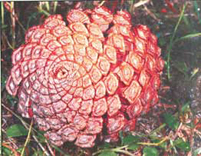

Count the number of spirals going in one direction, and the number going in the other. You will find that these are always two numbers which are next to each other in the Fibonacci series (e.g. 8 and 13). A similar arrangement is found in the way pine cones are constructed, in snail-shell spirals, animal horns and in the arrangement of leaf buds on a stem.1
Computer modelling2 has apparently shown that the way in which a group of circles of varying sizes is most efficiently packed is in a series of spirals that have this Fibonacci patterning.3
Pleasing to artists
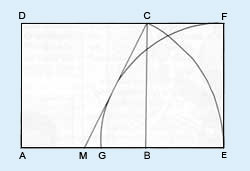
The so-called Golden Section (or Golden Ratio), known to most artists and architects, is also related to Fibonacci patterns. Most people, if asked to choose from a series of rectangles the one most pleasing to the eye, will choose one in which the ratio of the two sides (that is, the larger side divided by the smaller) is approximately 1.62.4 In other words, the long side is 1.62 times the length of the shorter. A rectangle framing the front of the famous ancient Greek building, the Parthenon (below), has sides which follow this ‘Golden Ratio’. This proportion is widely found in art and architecture.

Statistical experiments have shown that ‘people involuntarily give preference to proportions that approximate to the Golden Section.’5 This Golden Ratio (1.62, or 1.618 to four significant figures) seems to be naturally pleasing to the human eye. Authoritative works on art and architecture make bold claims in alleging, for example, that ‘the Golden Section is aesthetically superior to all other proportions’, which claim is said to be ‘supported by an immense quantity of data, collected from both nature and the arts …’.6
When we take the Fibonacci series (ignoring the zero), dividing each number by the one before it gives: 1, 2, 1.5, 1.6, 1.625, 1.615, 1.619, 1.617, 1.619, 1.617, 1.618 and so on ad infinitum. After the first few, the numbers keep hovering around 1.618. To three significant figures, they stay precisely on this Golden Ratio of 1.62 indefinitely.
Returning to living things, we also see that when you count the spirals on a sunflower hub one way, then the other way, dividing the larger number by the smaller gives this same Golden Ratio.
Unexplained link-ups
Why should there be all these fascinating and unexplained linkups between things which are mathematically beautiful and things which are beautiful to the human eye? And why do these in turn link up to number patterns found in living things?
A mathematician, when interviewed on television in relation to some of these matters said:
‘I personally believe there is some greater deity that’s organized it. Everything is too cleverly organized, as far as I’m personally concerned, to have just happened by happenchance. Whether you say all this was constructed by God, or whether you believe in some other way of doing it, I’m not quite sure, but yes, I think there is some power behind it all, but what it is I have no idea.’7
Unfortunately, our young people are being indoctrinated in humanist/evolutionary fallacies which try to deny the logical conclusion of intelligent design. For example, it is commonly claimed that nature (chance) invented man’s mind, which invented mathematics.8 How then is it that we find the same mathematical patterns in nature as in that which appeals to our sense of beauty?
Surely it is more logical to conclude that the connections exist because nature, mathematics and the human mind, with its subtle sense of beauty, have one supreme link — they are all the created products of God, the Master Designer.
Re-posted on homepage: 7 June 2023
References
- Encyclopædia Britannica 7:279, 1992. Apparently, Fibonacci numbers also feature in the genealogy of descent of the male bee, but no details are provided. Return to text.
- This was stated without detail on a Quantum television program, screened by Australian Broadcasting Commission, November 13, 1991. Return to text.
- New Scientist, April 18, 1992, p. 18. Also Physical Review Letters 68:2098. French physicists have built a physical model which seems to show that such ‘Fibonacci spiralling’ is a result of the system’s keeping the energy required for the growth of its parts (for example, the seeds) to a minimum. Return to text.
- Dividing any line (AB) by a point (C) such that AB/AC = AC/BC will ensure that these fractions equal the golden ratio, no matter how long the line. Return to text.
- The Oxford Companion to Art, Ed. Harold Osbome, First Edition, Oxford University Press, Oxford, p.489, 1978. Return to text.
- Ibid. p.488. This claim could still be so, even if it should be claimed that the Parthenon proportions mentioned were deliberately chosen because of Greek fascination for numbers and geometry. Leonardo da Vinci was fascinated by this Golden Section, or ‘divine proportion’ as it was also called, particularly in relation to the proportions of the human body. See also The Geometry of Art and Life by Matila Ghyka, and The Divine Proportion by H.E. Huntley, both available in Dover editions. Return to text.
- The speaker was Dr Michael Gore of the National Science and Technology Centre, Canberra, Australia (Ref. 2). Return to text.
- See Nickel, J., Why Does Mathematics Work?, J. Creation 4:147–157, 1990. Return to text.


Readers’ comments
Comments are automatically closed 14 days after publication.