

Ernst Haeckel
Evangelist for evolution and apostle of deceit

Known as ‘Darwin’s Bulldog on the Continent’ and ‘the Huxley of Germany’, Ernst Heinrich Philipp August Haeckel is notorious as the scientist who perpetrated fraud upon fraud to promote the theory of evolution.
Born at Potsdam, Prussia (now Germany), on February 16, 1834, Haeckel studied medicine and science at Würtzburg and the University of Berlin, and was professor of zoology at Jena from 1865 until his retirement in 1909. The turning point in his thinking was his reading of Charles Darwin’s Origin of Species, which had been translated into German in 1860.
In a letter to his mistress, written when he was 64 and had acquired the nickname of ‘Der Ketzer von Jena’ (the gadfly of Jena),1 he explained how he began as a Christian but after studying evolution became a free-thinker and pantheist.2
Darwin believed that Haeckel’s enthusiastic propagation of the doctrine of organic evolution was the chief factor in the success of the doctrine in Germany.3 Ian Taylor writes,
‘He became Darwin’s chief European apostle proclaiming the Gospel of evolution with evangelistic fervor, not only to the university intelligentsia but to the common man by popular books and to the working classes by lectures in rented halls.’4
In these he used enormous backdrops showing embryos, skeletons, etc., which has led to his presentation being described as a sort of ‘Darwinian passion play’!
The Imaginary Monera
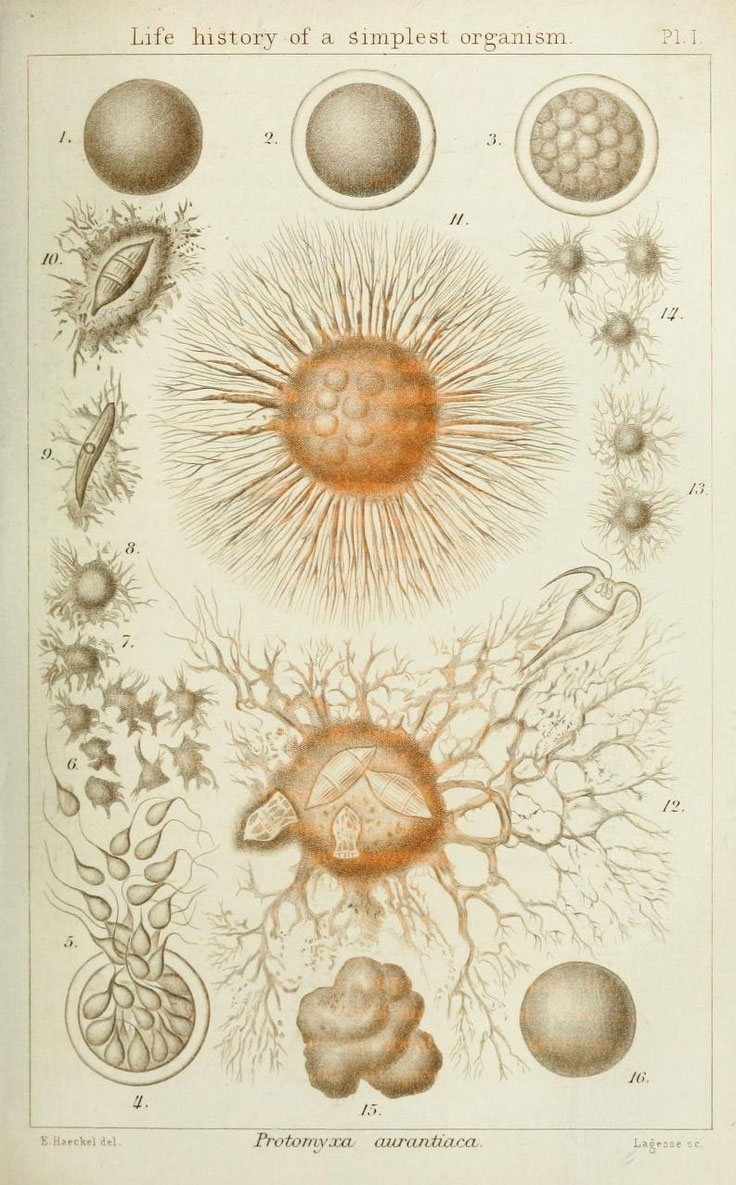
Haeckel’s enthusiasm for the theory of evolution led him to fraudulently manufacture ‘evidence’ to bolster his views. He was the first person to draw an evolutionary ‘family tree’ for mankind. To fill the gap in this between inorganic non-living matter and the first signs of life, he invented a series of minute protoplasmic organisms which he called Monera (plural of Moneron). These, he said, were
‘not composed of any organs at all, but consist entirely of shapeless, simple homogeneous matter … nothing more than a shapeless, mobile, little lump of mucus or slime, consisting of albuminous combination of carbon.’5,6
In 1868, a prestigious German scientific journal published 73 pages of his speculations, with more than 30 drawings of these imaginary Monera, as well as scientific names such as Protamoeba primitivia, and the process of fission by which they allegedly reproduced,7 even though his detailed descriptions and elaborate drawings were totally fictional, as these ‘life particles’ were entirely non-existent.
Later the same year, Thomas Huxley, Darwin’s champion in England, reported finding something that fitted Haeckel’s descriptions in mud samples that had been dredged from the bottom of the north Atlantic and preserved in alcohol. Huxley named them Bathybius haeckelii.8
Unfortunately for Huxley, Haeckel, the Monera, and the theory of evolution, in 1875 a chemist aboard the expeditionary ship discovered that these alleged protoplasm specimens were nothing more than amorphous gypsum, precipitated out of sea-water by alcohol!9 Haeckel refused to be moved by this confuting evidence, and for about 50 years the public continued to be duped by unrevised reprints of his popular The History of Creation (1876), complete with drawings of the Monera, until the final edition in 1923.;10,11
The Non-Existent Speechless Apeman

To Haeckel, human reasoning was much more important than facts and evidence. He believed that the only major difference between man and the ape was that men could speak and apes could not. He therefore postulated a missing link which he called Pithecanthropus alalus (speechless apeman) and even had an artist, Gabriel Max, draw the imagined creature, although there was not a scrap of evidence to support a single detail in the drawings.
A contemporary of Haeckel, Professor Rudolf Virchow (famous as the founder of cellular pathology and for many years president of the Berlin Anthropological Society), was scathing in his criticism—for Haeckel to have given a zoological name to a creature that no one had proved to exist was to him a great mockery of science.
The Dutch scientist, Professor G.H.R. von Koenigswald, described the drawing thus,
‘Under a tree a woman with long lank hair sits cross-legged suckling a child. Her nose is flat, her lips thick, her feet large, with the big toe set considerably lower than the rest. Beside her stands her husband, fat-bellied and low-browed, his back thickly covered with hair. He looks at the spectator good-naturedly and unintelligently, with the suspicious expression of an inveterate toper [habitual drinker]. It must have been a happy marriage; his wife could not contradict him, for neither of them could speak.’12
No such alleged ‘missing link’ has ever been found.
The Infamous ‘Fish Stage’ in Human Embryos
Of all Haeckel’s dubious activities, that for which he is most famous, or perhaps most infamous, is his promulgation of the totally erroneous theory that the human embryo is initially identical with that of other mammals and then goes through a series of stages where it has gills like a fish,13 a tail like a monkey, etc. Sometimes called ‘the law of recapitulation’ or Haeckel’s term ‘the biogenetic law’, this idea has been summarized in the mouthful, ‘ontogeny recapitulates phylogeny’, which means the development of the individual embryo repeats its alleged evolutionary history.
The first thing to say about this dictum, is that ‘law’ it is not! The idea is now known to be completely false. It is therefore not surprising that Haeckel could not find sufficient anatomical evidence to make his theory convincing. Never one to let lack of evidence stand in his way, Haeckel manufactured the ‘evidence’ by fraudulently changing the drawings of embryos by two other scientists.
In his book Natürliche Schöpfungs-geschichte (The Natural History of Creation), published in German in 1868 (and in English in 1876 with the title The History of Creation), Haeckel used the drawing of a 25-day-old dog embryo which had been published by T.L.W. Bischoff in 1845, and that of a 4-week-old human embryo published by A. Ecker in 1851–59.14 Wilhelm His, Sr (1831–1904), a famous comparative embryologist of the day and professor of anatomy at the University of Leipzig, uncovered the fraud.
Prof. Wilhelm His showed in 1874 that Haeckel had added 3.5 mm to the head of Bischoff’s dog embryo, taken 2 mm off the head of Ecker’s human embryo, doubled the length of the human posterior, and substantially altered the details of the human eye. He sarcastically pointed out that Haeckel taught in Jena, home of the then finest optical equipment available, and so had no excuse for inaccuracy. He concluded that anyone who engaged in such blatant fraud had forfeited all respect and that Haeckel had eliminated himself from the ranks of scientific research workers of any stature.15,16 [See also Encyclopedic ‘truth’ … or worldly wisdom?]
Haeckel’s Confession of Fraud

The furor in German scientific circles was so great that Haeckel found it impossible to persist in his policy of silence. In a letter to Münchener Allegemeine Zeitung, ‘an international weekly for Science, Art and Technology’, published on January 9, 1909, Haeckel (translated) wrote:
‘… a small portion of my embryo-pictures (possibly 6 or 8 in a hundred) are really (in Dr Brass’s [one of his critics] sense of the word) “falsified”—all those, namely, in which the disclosed material for inspection is so incomplete or insufficient that one is compelled in a restoration of a connected development series to fill up the gaps through hypotheses, and to reconstruct the missing members through comparative syntheses. What difficulties this task encounters, and how easily the draughts-man may blunder in it, the embryologist alone can judge.’17
Discerning readers who compare Haeckel’s doctored dog and human embryo pictures with the originals (see photographs), will readily see that Haeckel’s ‘confession’ was itself a deliberate misrepresentation of the facts and essentially an attempt to justify and perpetuate his shameful forgeries.
Despite this totally dishonest and grievously mischievous basis for the theory of embryonic recapitulation, and the fact that it has long since been discredited scientifically, the completely false idea that human beings retrace their evolutionary past in the womb has been taught as evidence for evolution in schools and universities in the past, and it is still included in many popular science books.18,19
Even worse, the argument that ‘the foetus is still in its fish stage so you are just cutting up a fish’ is used to this day by some abortionists to convince girls and young women that killing their offspring is OK.
Concerning this, Dr Henry Morris writes.
‘We can justifiably charge this evolutionary nonsense of recapitulation with responsibility for the slaughter of millions of helpless, pre-natal children —or at least for giving it a pseudo-scientific rationale.’20
Haeckel and the Rise of Nazism
Sadly, in spite of all of his unsavoury activities, Haeckel was overwhelmingly successful in Germany, not only in having evolution widely taught as the accepted story of origins, but also in imposing a unique form of social Darwinism and racism on the German national ethos. ‘He became one of Germany’s major ideologists for racism, nationalism, and imperialism.’21,22
This involved the concept that the Germans were members of a biologically superior community (akin to Nietzsche’s ‘super-man’).
Unfortunately for mankind, Haeckel’s evolutionism laid the foundation for the intense German militarism that eventually contributed to World War I. And then,
‘Social Darwinism, racism, militarism, and imperialism finally reached their zenith in Nazi Germany under the unspeakable Adolph Hitler … Hitler himself became the supreme evolutionist, and Nazism the ultimate fruit of the evolutionary tree.’23
Thus, through his obsession with the anti-God precepts of evolution and his shameful fabrication of spurious data, Haeckel provided the malign influence and pernicious inspiration that were the indirect cause of two world wars and the atrocities of the holocaust.24

Re-posted on homepage: 4 February 2015
References and Footnotes
- Ian Taylor, In the Minds of Men, TFE Publishing, Toronto, 1984, p. 184, who cites Peter Klemm, Der Ketzer von Jena, Urania Press, Leipzig, 1968. [Editorial note: The straightforward translation of ‘Ketzer’ is ‘heretic’. See comment by Rocco P. below and our response.] Return to text.
- Letter dated February 22, 1898, from Haeckel to Franziska von Altenhausen, a pseudonym to conceal the identity of Frida von Uslar-Gleichen. Source: Ian Taylor, Ref. 1, pp. 186 and 452 notes 8 and 10, who quotes Johannes Werner, The love letters of Ernst Haeckel written between 1898 and 1903, Harper and Brothers, New York, ed. 1930, p. 28. Return to text.
- Encyclopædia Britannica 11:69, 1962. Return to text.
- Ref. 1, p. 185. Return to text.
- Ernst Haeckel, The History of Creation, translated by E. Ray Lankester, Kegan Paul, Trench & Co., London, 1883, 3rd ed., Vol.1, p. 184. Return to text.
- Haeckel’s drawings of the life-cycle of his alleged Protomyxa aurantiaca are here reproduced from Ref. 5, Vol.1, plate I, facing p. 184. Haeckel described this non-existent substance thus: ‘The Protomyxa aurantiaca is distinguished from the other Monera by the beautiful and bright orange-red colour of its perfectly simple body, which consists merely of primæval slime, or protoplasm.’ Ref. 5, Vol.2, p. 380. Return to text.
- Ref. 1, pp. 187, 452 note 11, which quotes Ernst Haeckel, ‘Monographie der Moneren’, Jenaische Zeitschrift für Medizin und Naturwissenschaft, Leipzig 4:64, 1868. Return to text.
- Ref. 1, pp. 187, 452 note 12, which quotes Thomas Huxley, ‘On some organisms living at great depths in the North Atlantic Ocean’, Quarterly Journal of Microscopical Science, London 8:204, 210, 1868. Return to text.
- Ref. 1, pp. 188, 452 notes 14 and 15, which quote John Murray, ‘Preliminary report on the scientific results of the voyage of HMS Challenger’, Proceedings of the Royal Society of London, 1875–76, 24:471; and J.Y. Buchanan, ibid.4:593. Return to text.
- Ref. 1, pp. 189–90, 452 note 18. Return to text.
- Concerning the title of this book, Haeckel wrote on p. 7 of Vol.1, ‘Perhaps nothing will make the full meaning of the theory of descent clearer than calling it “the non-miraculous history of creation”? I have therefore chosen that name for this work.’ This intention is rather more obvious in the original German title, Natürliche Schöpfungsgeschichte, which means The Natural History of Creation Return to text.
- Cited from Herbert Wendt, From Ape to Adam, Thames and Hudson Ltd, London, 1971, p. 82. Return to text.
- In fact, the creases in the human embryo which Haeckel referred to as ‘gill slits’ have no connection with breathing, but develop into ear and jaw areas. Return to text.
- Ref. 1, pp. 276, 469, 472, which reference T.L.W. Bischoff, Entwicklungsgeschichte des Hunde Eies, F. Vieweg, Braunschweig, Germany, 1845; and A. Ecker, Icones Physiologicæ, L. Voss, Leipzig, 1851–59. Return to text.
- Adapted from ref. 1, pp. 276, 475, which references Wilhelm His, Unsere Körperform, C.W. Voegel, Leipzig, 1874. Return to text.
- It is noteworthy that the latest (15th) edition of Encyclopædia Britannica, committed as it is to evolution, makes no mention of Haeckel’s many fabrications. The 1992 printing says merely, ‘Haeckel tended to speculate’, ‘his concepts of recapitulation were in error’, and he ‘was often involved in controversy’, Encyclopædia Britannica, 5:610, 1992. Return to text.
- Cited from ‘The Truth about Haeckel’s Confession’, The Bible Investigator and Inquirer, M.L. Hutchinson, Melbourne, March 11, 1911, pp. 22–24. Return to text.
- E.g. Raymond Hawkey’s three dimensional book, Evolution, Michael Joseph Ltd, London, 1986, which states on the front cover that it was ‘produced in collaboration with the British Museum (Natural History)’, and on the back cover, ‘Like many other animals, human beings retrace much of their evolutionary past in the womb … By the time it [the human foetus] is 28 days old it resembles our earliest vertebrate ancestor, the fish. Like a fish it has … what appear to be four gill slits.’ Return to text.
- Professor Stephen Jay Gould of Harvard University has written, ‘Both the theory [of recapitulation] and “ladder approach” to classification that it encouraged are, or should be, defunct today.’ ‘Dr Down’s Syndrome’, Natural History 89:144, April 1980; cited from Henry Morris, Ref. 20, p. 139. Return to text.
- Henry Morris, The Long War Against God, Baker Book House, Michigan, 1989, p. 139. Return to text.
- Daniel Gasman, The Scientific Origins of National Socialism: Social Darwinism in Ernst Haeckel and the German Monist League, American Elsevier, New York, 1971, pp. xvi, xvii, cited from Henry Morris, op. cit., p. 73. Return to text.
- See also ‘Biological Sciences and the Roots of Nazism’, American Scientist 76:56, January–February 1988; cited from Henry Morris, op. cit., p. 73. Return to text.
- Henry Morris, op. cit., p.75. Return to text.
- It is worth noting that, in the experience of many creationist ministries, the practice of malicious fabrication in the cause of evolutionism did not die out with Haeckel! Return to text.
- These drawings occur in Ref. 5, Vol. 1, Plate III, facing p. 306. Return to text.
- These drawings taken from Creation Research Society Annual 6(1):31, June 1969. Return to text.


Readers’ comments
Comments are automatically closed 14 days after publication.